
Yardtally is reader-supported. Some links on this page are affiliate links. As an Amazon Associate, Yardtally earns from qualifying purchases. See our Affiliate Disclosure.
Topsoil Calculator
Use this topsoil calculator to find out exactly how much topsoil, fill dirt, or compost you need. It depends on three things: the area you’re covering, how deep you need it, and whether you’re using straight topsoil, fill dirt, compost, or a blend. The calculator above turns your measurements into the numbers suppliers use — cubic yards and tons for bulk orders, or a bag count if you’re picking up bags from the garden center. Plug in your space, choose your material, and you’ll know exactly what to order before you make the call.
How much topsoil or fill dirt do you need?
Enter your area and depth. Pick a material to get tons, cubic yards, and bag count.
Estimate only — actual weight varies with moisture content. Wet soil can weigh 20–30% more than dry. Order about 10% extra to cover settling and uneven ground.
| Area | 2" deep | 4" deep | 6" deep | 12" deep |
|---|---|---|---|---|
| 100 sq ft | 0.62 yd³ | 1.23 yd³ | 1.85 yd³ | 3.70 yd³ |
| 200 sq ft | 1.23 yd³ | 2.47 yd³ | 3.70 yd³ | 7.41 yd³ |
| 500 sq ft | 3.09 yd³ | 6.17 yd³ | 9.26 yd³ | 18.52 yd³ |
| 1,000 sq ft | 6.17 yd³ | 12.35 yd³ | 18.52 yd³ | 37.04 yd³ |
One cubic yard = 27 cubic feet. Tonnage depends on material — topsoil averages about 1 ton per yard; compost is closer to 0.6 tons per yard.
How deep should topsoil be?
Depth depends entirely on what you’re doing with the soil. For overseeding or patching an existing lawn, 1 to 2 inches of topsoil spread over the surface is enough to give new seed a place to take root. For establishing a brand-new lawn from scratch, you want 4 to 6 inches of quality topsoil over the subgrade. Garden beds and flower borders usually need 6 to 12 inches, depending on what you’re growing and what’s underneath — if the existing ground is hard clay or compacted fill, go deeper. And for raised beds, the depth is simply whatever your frame height is minus a couple of inches for settling.
The most common mistake is going too shallow. A thin layer of topsoil over hard ground looks fine for a few weeks, but roots hit the barrier underneath and the grass or plants struggle once summer heat arrives. If you’re investing in new soil, give it enough depth to actually work. Before you order, a soil test kit can tell you what your existing ground is missing — pH, nitrogen, phosphorus, potassium — so you know whether straight topsoil is enough or whether you need compost or amendments mixed in.
What’s the difference between topsoil and fill dirt?
These two get confused constantly, but they serve completely different purposes. Topsoil is the nutrient-rich top layer of earth — the dark, organic stuff that plants actually grow in. Fill dirt is the dense, clay-heavy subsoil underneath, and it contains almost no organic material or nutrients. Plants won’t grow in fill dirt alone, but that’s not what it’s for.
Fill dirt is for changing grade, filling holes, building up low spots, and creating a stable base under structures like patios, sheds, and driveways. Topsoil goes on top of that — it’s the growing layer. If you’re leveling a yard and then planting, you typically need fill dirt first to get the grade right, then 4 to 6 inches of topsoil on top for the lawn or garden to root into. The calculator handles both — just select the right material and the density adjusts automatically, since fill dirt is significantly heavier than topsoil.
Should you buy topsoil in bags or bulk?
For anything under about half a cubic yard — a small garden patch, a few low spots in the lawn — bagged topsoil from a garden center is the easier move. No delivery to schedule, no pile in the driveway, and you can load exactly what you need into the car. Once you pass roughly one cubic yard, bulk is almost always the better deal. A cubic yard of topsoil delivered runs anywhere from $25 to $60 depending on your area, while the same volume in bags would cost several times that.
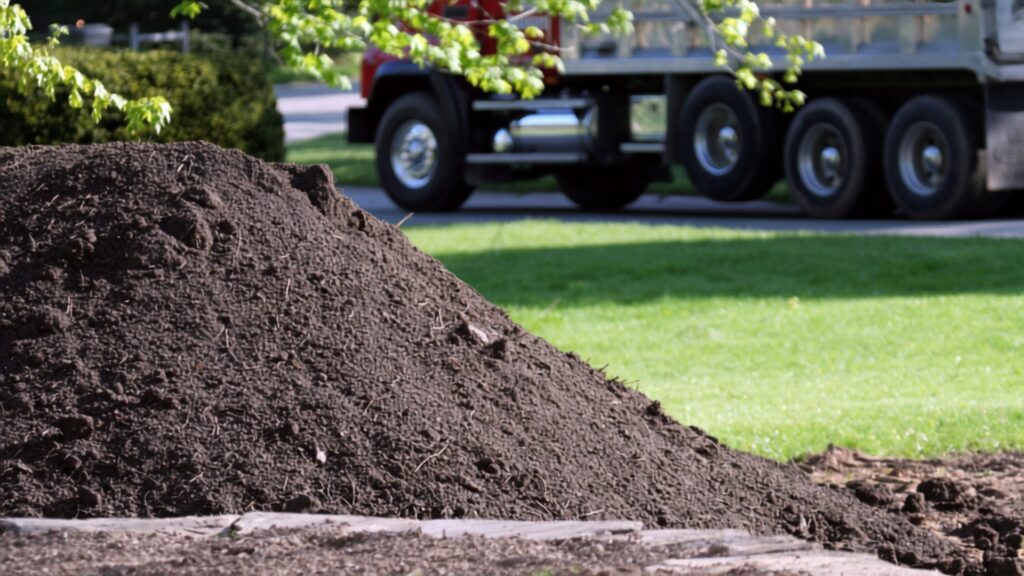
The calculator shows both bag count and cubic yards specifically so you can compare. If the bag number looks painful (40, 50, 80 bags), that’s the calculator telling you to call a landscape supply yard instead. Most will deliver for a flat fee, and some will waive it for larger orders. One thing to plan for: bulk soil gets dumped in a pile on your driveway or yard, and you’ll need a wheelbarrow and a landscape rake to move and spread it — plus a few hours of honest work.
What about garden soil, compost, and blends?
The calculator includes these because they’re closely related and often bought alongside topsoil. Garden soil is essentially topsoil that’s been amended with compost and other organics — it’s lighter, drains better, and is ready to plant in without much modification. Compost on its own is the lightest option, great for topdressing existing beds or mixing into heavy clay soil to improve structure and drainage.
If you go through compost regularly, an outdoor compost tumbler pays for itself quickly and gives you a steady supply of free amendment without buying bags every season. A 50/50 topsoil and compost blend is one of the most popular products at landscape yards — it splits the difference between structure and nutrition and works well for new garden beds and lawn renovation.
Each material weighs differently per cubic yard, which matters if you’re hauling it yourself or ordering by the ton. Topsoil runs about 2,000 to 2,200 pounds per cubic yard; compost is closer to 1,000 to 1,200. The calculator adjusts the tonnage automatically when you switch materials, so you always get the right weight for what you’re actually buying.
What you’ll need for the job
Before you place an order, a soil test kit takes the guesswork out of what your ground actually needs — it tells you the pH and nutrient levels so you’re not buying amendments you don’t need or skipping ones you do. For spreading and leveling bulk soil, a landscape rake gets the surface even faster than a shovel and back-dragging. You’ll need something to move the pile — a wheelbarrow handles smaller loads, or a dump garden cart carries more volume and tips out without lifting. And if you’re adding compost regularly to your beds or lawn, an outdoor compost tumbler gives you a free, steady supply instead of buying bags every spring.
Common questions
How much topsoil do I need for a 10×10 area?
A 10×10 area (100 square feet) at 6 inches deep needs about 1.85 cubic yards of topsoil — roughly 1.9 tons. At 4 inches deep it drops to about 1.23 cubic yards. Either way, that’s solidly in bulk-delivery territory rather than bags.
How many bags of topsoil are in a cubic yard?
About 27 bags if you’re buying the standard 1-cubic-foot size, or 18 bags of the 1.5-cubic-foot size. This is why bulk wins on cost for anything beyond a small patch — you’d be hauling and ripping open a lot of bags to equal one delivered yard.
How much does a cubic yard of topsoil weigh?
A cubic yard of dry topsoil weighs roughly 1.8 to 2.2 tons — about 2,000 pounds on average. Wet topsoil can weigh 20 to 30 percent more, which matters if you’re loading a truck or trailer. A standard half-ton pickup can safely carry about half a cubic yard, so plan two trips or pay for delivery on larger orders. For moving soil around the yard once it’s delivered, a dump garden cart handles heavier loads and tips more easily than a traditional wheelbarrow.
Can I use fill dirt instead of topsoil?
Only if you’re not planting anything in it. Fill dirt is for building grade and filling voids — it’s stable and compacts well, but it has no nutrients and won’t support plant growth. If you need to raise an area and then grow a lawn or garden on top, use fill dirt for the base and topsoil for the top 4 to 6 inches.
How deep should topsoil be for a new lawn?
For a new lawn from seed or sod, 4 to 6 inches of topsoil gives roots enough depth to establish a healthy, drought-resistant root system. Going thinner than 4 inches often leads to thin, stressed grass that struggles in heat and dries out quickly. If the soil underneath is decent (not pure clay or rock), you can sometimes get away with 3 to 4 inches and amend what’s already there.
Working on the rest of the yard? Our Gravel Calculator covers driveways, paths, and patios, the Concrete Per Fence Post Calculator handles setting posts the right way, and the Raised Bed Soil Calculator tells you exactly how much soil, compost, and aeration to fill your garden beds — all free, no math required.