
Yardtally is reader-supported. Some links on this page are affiliate links. As an Amazon Associate, Yardtally earns from qualifying purchases. See our Affiliate Disclosure.
Tree Mulch Ring Calculator
Enter your tree trunk size and how wide you want the mulch ring — get cubic feet, cubic yards, and exact bag count.
Your Mulch Ring Results
Application Tips
Recommended Mulch Products
As an Amazon Associate, Yardtally earns from qualifying purchases. Prices vary — check Amazon for current pricing.
How Much Mulch Does a Tree Ring Need?
The math for a tree mulch ring is a donut, not a square. You’re calculating the area of a circle at the outer edge of the ring minus the area of the circle at the inner edge — the trunk plus the required clearance gap. Most online calculators treat it like a flat ring, but the correct formula accounts for the gap you should always leave around the trunk itself. That gap matters.
The Right Depth for Tree Mulch
Three inches is the standard recommendation for most trees. That’s deep enough to suppress weeds, retain moisture, and regulate soil temperature — the three things mulch is actually there to do. It’s also shallow enough to let air and water reach the root zone without creating the oxygen-starved environment that deeper layers can cause.
Two inches is appropriate for maintaining an existing ring that hasn’t broken down completely. Four inches is the absolute maximum — going deeper doesn’t improve any of the benefits and starts to work against the tree by blocking gas exchange at the soil surface. Source: University of Minnesota Extension — Mulching for Soil and Garden Health
How Wide Should a Tree Mulch Ring Be?
The general rule is to extend the ring as far as the drip line — the outer edge of the tree’s canopy. That’s where the feeder roots are most active, and mulch over that zone delivers the most benefit. In practice, most homeowners don’t have room for a full drip-line ring on established trees in a maintained lawn, so a ring of 3 to 8 feet in diameter is the common compromise.
For young trees, even a 3-foot ring makes a meaningful difference — it eliminates mower and string trimmer contact with the trunk, which is one of the leading causes of damage to young trees. As the tree grows, expanding the ring is easy and worth doing.
The Volcano Mulching Problem
Volcano mulching — piling mulch up against the trunk in a cone shape — is one of the most common and damaging tree care mistakes homeowners make. It looks intentional, which is probably why it became so widespread, but it causes serious problems. Mulch pressed against bark traps moisture, promotes fungal disease, creates entry points for insects and rodents, and can girdle the trunk over time as roots grow into the mulch pile rather than into the soil.
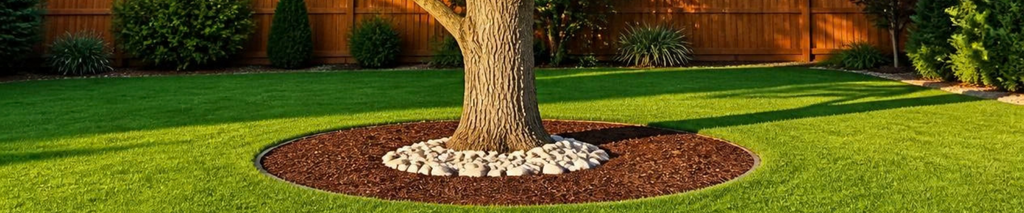
The correct shape is a donut, not a volcano. Mulch should be pulled back 3 to 6 inches from the trunk and kept at an even depth across the ring. If you can see the root flare — the slightly widened base where trunk transitions to root — you have the clearance right. Source: International Society of Arboriculture — Proper Mulching Techniques
What Type of Mulch Is Best for Trees?
Shredded wood and bark mulches are the most popular and practical choice for tree rings. They break down slowly, add organic matter to the soil, and look clean for a full season before needing refresh. Coarser wood chip mulch from arborist chips breaks down faster and feeds soil biology more actively — it’s the preferred choice of many arborists for long-term tree health, though it looks less finished than shredded bark.
Avoid rubber mulch and landscape fabric under tree rings. Rubber doesn’t decompose and contributes nothing to soil health. Landscape fabric eventually breaks down into the soil and creates a barrier that prevents feeder roots from accessing the mulch layer above. Both are marketed as low-maintenance solutions but cause more problems than they solve in a tree ring context.
How Often Do You Need to Refresh Tree Mulch?
Organic mulch breaks down over time, which is actually the point — that decomposition is what feeds the soil. Most shredded wood mulches need refreshing every one to two years. Check depth in early spring: if the existing layer has compacted to less than two inches, it’s time to add more. Pull the old mulch back lightly to break up any compacted crust before adding fresh material on top.
Don’t remove the old mulch unless it’s heavily compacted or showing signs of mold or matting. A thin base of partially decomposed mulch underneath fresh material is beneficial — it’s actively adding organic matter to the soil.