
Yardtally is reader-supported. Some links on this page are affiliate links. As an Amazon Associate, Yardtally earns from qualifying purchases. See our Affiliate Disclosure.
Finding mold in your house triggers an immediate question — is this the dangerous kind, or can I just clean it up? The answer depends on the type of mold, how much of it there is, and where it’s growing. Most household mold is not the toxic black mold people fear, and most small mold problems can be handled by a homeowner with basic supplies. But some situations require a professional, and knowing the difference protects both your health and your wallet. This guide covers how to identify what you’re dealing with, what the health risks actually are, and exactly what to do about it.
WHAT’S IN THIS GUIDE
- Types of Household Mold
- Is Black Mold Dangerous?
- Health Effects of Mold Exposure
- How to Identify Mold in Your House
- When to Clean It Yourself vs. Call a Pro
- How to Clean Mold Yourself
- How to Prevent Mold from Coming Back
- Frequently Asked Questions
Types of Household Mold
There are hundreds of mold species, but a handful account for most of what homeowners find in their houses. Understanding the difference matters because the type of mold determines the health risk and the appropriate response.
Cladosporium is one of the most common household molds. It appears olive-green, brown, or black and typically grows on fabric, carpet, wood surfaces, and the back of painted walls. It is allergenic — meaning it can trigger allergic reactions and asthma symptoms — but it is not considered toxic. Most people with healthy immune systems tolerate brief exposure without serious effects.
Penicillium is the blue-green mold most people recognize from spoiled food. It also grows on water-damaged wallboard, insulation, and carpet. It spreads quickly and produces a musty odor. It is allergenic and can cause respiratory symptoms in sensitive individuals, but like Cladosporium, it is not considered toxic.
Aspergillus is a very common mold that appears in many colors — gray, white, green, yellow, or brown. It grows on walls, insulation, and paper-based building materials. Most Aspergillus species are allergenic, but some produce mycotoxins and can be pathogenic — meaning they can cause lung infections in people with weakened immune systems, the elderly, and infants.
Stachybotrys chartarum — commonly called toxic black mold — is the species most people fear. It is dark greenish-black, slimy in texture, and requires sustained, heavy moisture to grow — it doesn’t show up after a single leak. It is less common than the other types and requires a specific set of conditions, but it does produce mycotoxins that are harmful with prolonged exposure. Source: Cleanipedia — Is Mould Dangerous?
Is Black Mold Dangerous?
Black mold is the term most homeowners use for any dark-colored mold, but the color alone doesn’t tell you much. Several common molds are black or very dark — Cladosporium and Alternaria are both frequently dark-colored and are far more common than Stachybotrys chartarum, the species that actually produces mycotoxins.
True toxic black mold (Stachybotrys chartarum) is dangerous, but it’s also significantly rarer than the coverage it gets. It requires sustained moisture over weeks or months to establish itself — it is typically found in homes with long-term water damage, chronic leaks, or flooding that wasn’t properly dried out. Finding dark mold in your bathroom grout or on a window sill is almost certainly not Stachybotrys.
The only way to confirm the species of mold in your house is through testing. A mold test kit can identify whether what you’re seeing is a common allergenic mold or something more serious. For large infestations or any mold growing in HVAC systems, behind walls, or in crawl spaces, a professional air quality test is more reliable than a surface swab kit. Source: Tom’s Guide — How Dangerous Is Mold in Your Home?
The practical answer to “is black mold dangerous?” is this: any mold in your house is a problem that should be addressed, because even non-toxic molds cause health symptoms in sensitive individuals and all mold indicates a moisture problem that will worsen over time. But most household mold does not require emergency evacuation or a hazmat team — it requires prompt, methodical cleanup and fixing the moisture source.
Health Effects of Mold Exposure
Mold affects people differently depending on the species, the amount of exposure, and individual sensitivity. Some people live with mold in their home for months without noticeable symptoms; others react immediately to small amounts.
The most common health effects of mold exposure are respiratory — coughing, wheezing, nasal congestion, and throat irritation. These symptoms are caused by inhaling mold spores, which trigger an inflammatory response in the airways. People with asthma, allergies, or chronic respiratory conditions are significantly more sensitive than healthy adults.
Allergic reactions are the second most common response — sneezing, runny nose, red eyes, and skin rash. These reactions can occur with any allergenic mold species and are not limited to toxic black mold. People with mold allergies may react to even small amounts.
In people with compromised immune systems — those undergoing chemotherapy, organ transplant recipients, people with HIV, the elderly, and infants — pathogenic molds like certain Aspergillus species can cause serious lung infections. This is the population most at risk from mold exposure, and they should avoid any area with visible mold growth until it is fully remediated.
Toxic black mold (Stachybotrys) produces mycotoxins that, with prolonged exposure, can cause more serious symptoms including severe respiratory distress, chronic fatigue, persistent headaches, and in extreme cases, pulmonary hemorrhage. These severe outcomes are associated with long-term exposure to heavy infestations — not brief contact with a small patch. Source: BMS CAT — Is Black Mold Dangerous?
How to Identify Mold in Your House
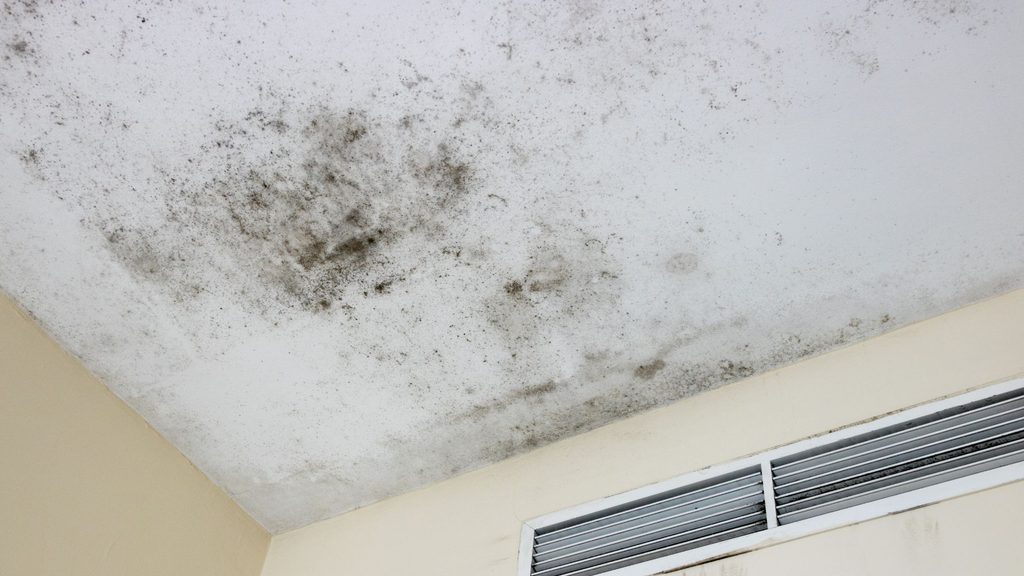
Mold is most often identified by sight and smell before anything else. Visible mold appears as discolored patches — black, green, white, gray, or orange — with a fuzzy or slimy texture. It typically appears in areas with moisture: bathroom grout, caulk lines, under sinks, around window frames, on basement walls, and on ceiling tiles.
The musty smell that accompanies mold is often detectable before the mold itself is visible. If a room, closet, or basement consistently smells musty despite cleaning, there’s likely mold in your house growing in a hidden location — behind a wall, under flooring, or inside a ceiling cavity. A moisture meter can help pinpoint areas of elevated moisture where hidden mold is likely growing even when nothing is visible.
Mold on hard, non-porous surfaces (tile, glass, metal) looks different from mold on porous materials (drywall, wood, grout). On hard surfaces it sits on top and can be wiped away. On porous materials it grows into the material itself and can’t be fully removed by surface cleaning — the material usually needs to be replaced.
Mold vs. mildew — what’s the difference?
Mildew is a surface fungus that appears as a flat, powdery white or gray growth, most commonly on bathroom tile and shower walls. It stays on the surface and is easy to clean with a standard bathroom cleaner. Mold grows deeper into the material, has a raised or fuzzy texture, and is typically darker in color. If wiping the spot with a damp cloth removes it completely and it doesn’t come back within a day or two, it was likely mildew. If it persists or comes back quickly, it’s mold.
When to Clean It Yourself vs. Call a Pro
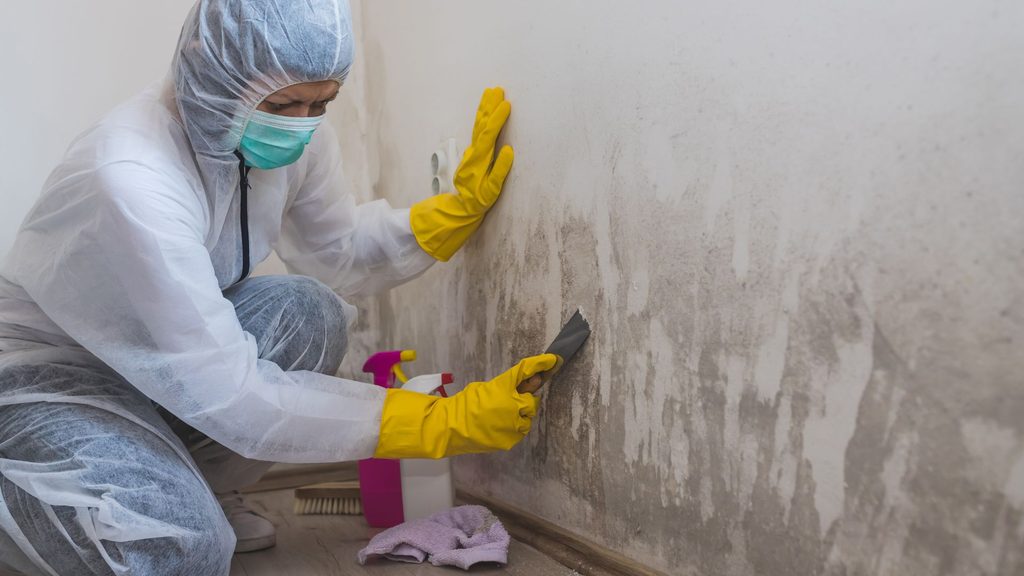
The EPA’s general guideline is that homeowners can handle mold cleanup themselves when the affected area is less than 10 square feet — roughly a 3-by-3-foot patch. Anything larger than that, or mold that keeps coming back after cleaning, warrants professional assessment.
Call a professional when:
- The mold covers more than 10 square feet
- The mold is in your HVAC system, ductwork, or air handler
- The mold is inside walls, under floors, or in the attic insulation
- You have confirmed or suspected Stachybotrys (toxic black mold)
- Anyone in the household has respiratory issues, a compromised immune system, or is an infant
- The mold came back after you cleaned it more than once
- You smell mold but can’t find it
Clean it yourself when:
- The affected area is under 10 square feet
- It’s on a hard, non-porous surface (tile, tub surround, sink)
- It’s surface mold on bathroom grout or caulk
- The moisture source has been identified and fixed
- No one in the household has respiratory conditions or a compromised immune system
Never paint over mold — it doesn’t kill it and doesn’t stop it from growing. The mold will grow through the paint within weeks and the underlying moisture problem will continue to worsen.
How to Clean Mold Yourself
Before you start, protect yourself. Wear work gloves , an N95 or better dust mask, and safety goggles. Open windows to ventilate the area, and close doors to prevent spores from spreading to other rooms.
For hard, non-porous surfaces — tile, tub surrounds, sinks, and glass — a solution of one cup of bleach to one gallon of water is effective. Apply it to the surface, let it sit for 10–15 minutes, scrub with a brush, and rinse thoroughly. Bleach kills mold on contact on non-porous surfaces and prevents regrowth.
For porous surfaces — drywall, wood, grout, and caulk — bleach is not the right solution. The water in bleach soaks into the material and can actually feed mold growth deeper in the substrate. For porous surfaces, use an antimicrobial spray specifically formulated for porous materials. These penetrate the surface rather than sitting on top of it.
In most cases, caulk that has mold growing in it cannot be fully cleaned — the mold is inside the caulk material, not just on the surface. The right fix is to remove the old caulk with a utility knife, clean the surface underneath, let it dry completely, and apply fresh waterproof silicone caulk. This takes 30 minutes and costs a few dollars — far less than a wall repair from ignored mold.
After cleaning, the most important step is addressing the moisture source. Mold cleaned without fixing the source will return within days. Identify what caused the moisture — a leak, failed caulk, inadequate ventilation, or condensation — and fix it before considering the job done. A dehumidifier in a chronically damp area like a basement or bathroom can keep humidity below the 60% threshold where mold thrives.
How to Prevent Mold from Coming Back
Mold needs three things to grow: moisture, a food source (virtually any organic material), and a surface to attach to. You can’t eliminate food sources or surfaces in a home, but you can control moisture — and that’s the entire game.
Keep indoor humidity below 60% — ideally between 30–50%. A humidity monitor in your basement, bathroom, and any problem areas lets you track humidity levels and take action before mold can establish itself.
Ventilate bathrooms and kitchens during and after use. A bathroom exhaust fan should run during every shower and for 15–20 minutes afterward to remove steam before it condenses on walls and ceilings. If your bathroom exhaust fan doesn’t clear the steam within 20 minutes, it’s undersized for the room or the duct run is too long.
Fix leaks immediately. A slow drip under a sink or a failed caulk line around a tub seems minor — but it’s all the moisture mold needs. Most mold infestations behind walls, under floors, and in crawl spaces trace back to a small leak that was ignored or undetected for weeks or months.
Check your crawl space and basement regularly. These are the highest-risk areas in most homes because they have limited ventilation, direct contact with soil moisture, and are often ignored for long periods. A vapor barrier on a crawl space floor and proper ventilation significantly reduce moisture intrusion. In a basement, make sure downspouts are directing water well away from the foundation and that the grade slopes away from the house. Source: Cleanipedia — Is Mould Dangerous?
Frequently Asked Questions About Mold in the House
How do I know if the mold in my house is dangerous?
Color alone is not a reliable indicator — black mold is not always toxic, and toxic mold is not always black. The only way to confirm the species is through testing. As a practical rule, treat any mold in your house as a problem that needs to be addressed regardless of color. If the mold is widespread, in your HVAC system, or causing health symptoms, call a professional for assessment rather than attempting to identify the species yourself.
Can I stay in my house if there is mold?
For small, isolated patches of surface mold on non-porous materials, staying in the house while you clean it up is generally safe for healthy adults. Keep the affected area ventilated, close off the room during cleanup to prevent spores from spreading, and address the moisture source promptly. If the mold is widespread, in the HVAC system, or causing health symptoms in anyone in the household — especially children, the elderly, or anyone with respiratory conditions — temporary relocation until remediation is complete is the safer choice.
Does bleach kill mold?
Bleach kills mold on hard, non-porous surfaces like tile and glass. It does not effectively kill mold on porous surfaces like drywall, wood, or grout — the bleach sits on the surface while the mold roots remain in the material. For porous surfaces, use a product specifically formulated to penetrate and treat mold in porous materials. And regardless of what you use to clean it, mold will return unless the moisture source is fixed.
What does toxic black mold smell like?
Toxic black mold (Stachybotrys chartarum) has a strong, earthy, musty odor — often described as rotting leaves, wet soil, or mildew amplified. However, the smell alone cannot confirm the species. All mold produces some degree of musty odor, and a strong smell does not necessarily mean toxic mold. If you smell mold but can’t find it visually, use a moisture meter to locate areas of elevated moisture behind walls and under floors, and consider professional air quality testing.
How long does it take for mold to grow after a water leak?
Mold can begin to grow within 24–48 hours of a water event if conditions are right — warm temperatures, high humidity, and an organic surface to grow on. This is why the first 24–48 hours after a leak, flood, or water damage event are critical. Drying affected materials within that window — with fans, dehumidifiers, and professional water extraction if needed — dramatically reduces the risk of mold establishing itself.
Is mold covered by homeowner’s insurance?
Mold coverage varies significantly by policy. Most standard homeowner’s insurance policies cover mold remediation if the mold in your house resulted from a covered sudden and accidental water event — a burst pipe or an appliance failure, for example. They typically do not cover mold that resulted from long-term neglect, gradual leaks, or flooding. Some policies include a specific mold remediation cap. Review your policy carefully and contact your insurer before beginning any remediation work.