

Yardtally is reader-supported. Some links on this page are affiliate links. As an Amazon Associate, Yardtally earns from qualifying purchases. See our Affiliate Disclosure.
If you have a sandbox with known interior dimensions, enter them here for a more accurate fill estimate.
This sand calculator figures out exactly how much sand you need before you buy — in cubic feet, cubic yards, pounds, and bag count. Whether you’re filling a sandbox, laying a paver base, leveling low spots in your lawn, or setting up a pool base, enter your dimensions and the calculator does the math. Just make sure you pick the right sand type first — play sand and all-purpose sand are not interchangeable, and using the wrong one for your project creates real problems.
Play sand vs. all-purpose sand — why it matters
This is the most important thing to know before you buy: play sand and construction sand (also called all-purpose sand) are completely different products. They look similar in the bag, but they serve different purposes and are not safe substitutes for each other.
Play sand is washed, screened, and processed specifically for contact with children. It’s fine-grained, free of sharp edges, and screened to remove contaminants. It’s the only sand that should go in a sandbox, sensory table, or children’s play area. Using construction sand in a play area exposes children to potentially harmful materials and sharper particles.
All-purpose sand is coarser, heavier, and designed for structural and landscaping use — paver base, pool underlayers, pipe bedding, and lawn leveling. It compacts well and drains properly in those applications. It’s not safe for sandboxes and it performs poorly in play area settings anyway since the coarser texture doesn’t pack into castles or molds the way play sand does.
The calculator above enforces this distinction automatically — it shows the correct affiliate link and notes for each sand type based on your selection. When in doubt, read the bag label.
How much sand does a sandbox need?
The most common question we get is how much play sand to buy for a standard backyard sandbox. The answer depends on the sandbox size and how deep you want to fill it — and the difference between a 4-inch fill and a 6-inch fill is significant.
A standard 4×4 sandbox filled to 6 inches deep needs about 8 cubic feet of sand — roughly 9 to 10 bags of 50 lb play sand. That same sandbox filled to only 4 inches needs about 5 cubic feet, or 6 to 7 bags. A larger 4×8 sandbox at 6 inches deep needs about 16 cubic feet — 18 to 19 bags.
Most sandbox manufacturers recommend a 6-inch fill depth for the best play experience. Less than that and the sandbox feels shallow; more than that wastes sand and can make it harder for small children to sit comfortably inside.
For the best play sand, look for a product labeled “washed” and “screened” — those words on the bag confirm it has been processed for safe use in children’s play areas.
How much sand do I need for a paver base?
The standard bedding layer under pavers, flagstone, and brick is 1 inch of coarse all-purpose sand. That sounds like a small amount, but it adds up quickly across a large patio or walkway.
A 10×10 patio at a 1-inch sand depth needs about 8.3 cubic feet of sand — roughly 10 bags of 50 lb all-purpose sand. A 12×20 patio needs about 20 cubic feet — around 24 bags. At that volume, it’s worth calling a local landscape supply yard to compare bulk pricing against bagged.
Use coarse all-purpose sand for paver base — not fine play sand, which can wash out from under the pavers and cause settling. The coarser grain locks in place better and provides stable, long-lasting support.
A few things to know about paver base sand: always screed it level before setting pavers, don’t compact the sand layer before placing pavers (the pavers compact it as you set them), and sweep polymeric sand — not regular sand — into the joints between pavers once they’re set.
How much sand for lawn leveling?
Lawn leveling with sand is one of those projects where less is more. The standard application is a quarter to half an inch topdressed over thin or uneven areas — thin enough that the grass blades are still visible through the sand after application. Burying the grass under too much sand smothers it.
For pure geometry, half an inch of sand over 1,000 square feet needs about 4 cubic yards — but in practice, you’re rarely covering the entire lawn. Most homeowners are filling specific low spots, which means the total quantity is much more manageable. Use the calculator above with your actual low spot dimensions to get an accurate number.
One important note for lawn leveling: straight construction sand isn’t the best topdressing material for clay-heavy soils. Sand mixed with compost in roughly a 50/50 blend performs better — the compost improves drainage and prevents the sand from compacting into a hard layer. If your soil is mostly clay, check our how to fix a bumpy lawn guide for the full topdressing method.
How to measure a circular area
If your project area is round — a circular sandbox, a round patio, or a circular pool — you need the diameter to use the circle mode in the calculator. The diameter is the distance straight across the widest point of the circle, measured through the center.
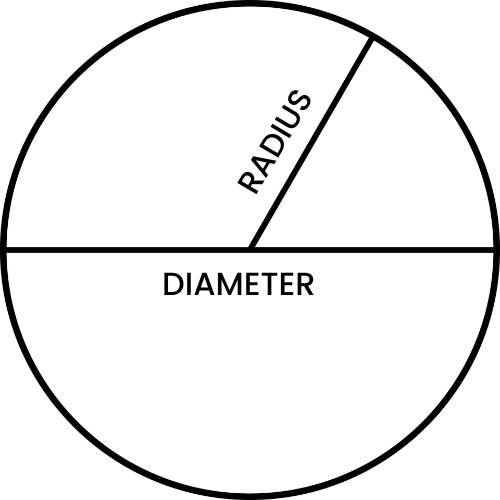
The easiest way to measure it: stretch a tape measure from one edge to the opposite edge, making sure the tape passes through the middle of the circle. That measurement is your diameter. If you only know the radius (the distance from the center to the edge), just double it — that’s the diameter.
Bags vs. bulk sand — which is the better buy?
For small projects — filling a sandbox, bedding a short paver path, or leveling a few low spots — bagged sand from Amazon or a local home improvement store is the practical choice. No minimum order, no delivery scheduling, and you can grab exactly what you need.
For larger projects — a full patio base, a pool underlayer, or any project requiring more than about half a cubic yard — bulk sand from a landscape supply yard becomes significantly cheaper. Bulk sand is sold by the cubic yard and delivered loose. A cubic yard is 27 cubic feet, which covers roughly 320 square feet at a 1-inch depth. At that scale, the per-cubic-foot cost of bulk is typically less than half the cost of bagged.
The calculator’s buy box flags which side of that line your project falls on based on the bag count it calculates.
Related calculators
Sand is often just one part of a bigger project. If you’re building or leveling a patio, the gravel calculator figures out how much base gravel you need before the sand layer goes down. Setting fence posts in that same project? The concrete calculator handles the concrete quantities. And if you’re topdressing the lawn around the project area, the topsoil calculator covers fill quantities for low spots.