
Yardtally is reader-supported. Some links on this page are affiliate links. As an Amazon Associate, Yardtally earns from qualifying purchases. See our Affiliate Disclosure.
How much concrete do you need?
Enter your post and hole dimensions. Pick your state to get the frost line depth.
Order 10% extra — bags can run short and a second trip costs more than a spare bag. Always round up.
| Post size | Hole size | 24" deep | 36" deep | 48" deep |
|---|---|---|---|---|
| 4×4 post | 8" hole | 1 bag | 2 bags | 3 bags |
| 4×4 post | 10" hole | 1 bag | 3 bags | 4 bags |
| 6×6 post | 12" hole | 1 bag | 3 bags | 4 bags |
| 6×6 post | 14" hole | 2 bags | 4 bags | 6 bags |
| 4" round | 10" hole | 1 bag | 3 bags | 4 bags |
| 6" round | 14" hole | 2 bags | 4 bags | 6 bags |
Enter your exact dimensions above for a precise number. Add 10% for waste.
How much concrete does a fence post need?
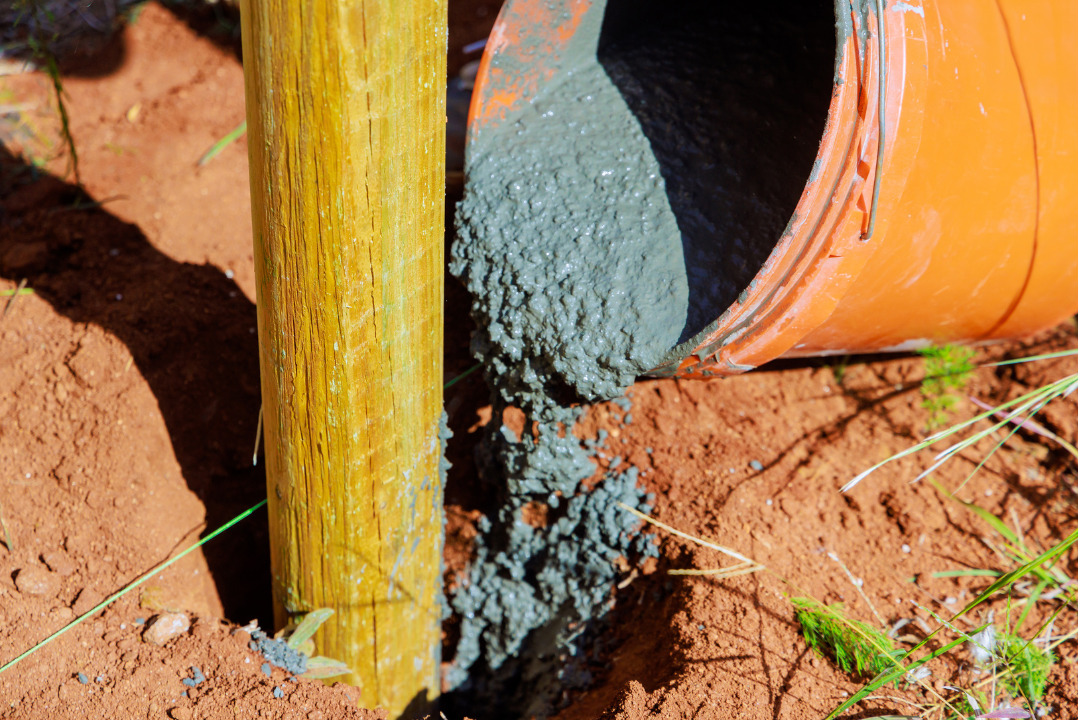
This concrete per fence post calculator tells you exactly how many bags of concrete — or how much you’ll mix from scratch — to set a single fence post, so you can buy the right amount the first time. The calculator subtracts the post volume from the hole volume to get the concrete you actually need — not just the hole volume, which overstates it. For a standard 4×4 post in a 10-inch diameter hole at 36 inches deep, you need about 1.4 cubic feet of concrete, which works out to 3 bags of 80 lb Quikrete.
How deep should fence post holes be?
This is where most people go wrong — and a post set too shallow will lean or heave out of the ground after the first hard freeze. The rule of thumb is one-third of the total post length, but the real governing factor is your local frost line. Your hole needs to go at least 6 inches below the frost depth for your area, or the ground will freeze around the concrete and push the post up over winter.
Pick your state in the calculator above and it will show you the frost line depth and the minimum hole depth for your location. Indiana, for example, has a 30-inch frost line — so posts should go at least 36 inches deep. Minnesota’s 60-inch frost line means posts need to be 66 inches deep, nearly twice as far. A manual post hole digger is the simplest way to dig clean, consistent holes at the right depth without renting equipment.
How wide should the hole be?
The standard rule is three times the post diameter. For a 4×4 post (3.5 inches actual), that’s about a 10-inch hole. For a 6×6 post (5.5 inches actual), use a 12-inch hole. A wider hole uses more concrete but gives the post a more stable base — worth it for tall fences, gates, and corner posts that take more lateral force.
Should you use fast-setting or regular concrete?
For most fence posts, a fast-setting concrete mix like Quikrete Fast-Setting is the easier choice. You pour it dry into the hole around the post, add water, and it sets in 20–40 minutes. No mixing required. It’s slightly more expensive per bag but saves significant time and effort on a multi-post job.
Regular concrete (Quikrete 5000 or similar) needs to be mixed in a mixing tub, wheelbarrow, or with a handheld concrete mixer but it’s cheaper per bag and gives you more working time if you’re setting a lot of posts at once. For more than 20 posts, mixing in batches is usually worth the extra work.
Either type works fine structurally — the choice is mostly about your timeline and how many posts you’re setting.
For the full step-by-step on setting posts, including hole depth and bracing, see Quikrete’s official guide to setting posts in concrete.
What you’ll need for the job
Once you’ve got your bag count from the calculator, here’s the short list for setting fence posts the right way. A bag of fast-setting concrete mix is the core material — one bag per shallow post, more for deeper holes (the calculator handles the math). You’ll need a post hole digger to get your holes to the right depth and diameter. A post level saves time and frustration by letting you check plumb on two sides before the concrete sets. If you’re mixing regular concrete instead of the dry-pour fast-setting type, a mixing tub keeps things contained, or a handheld concrete mixer speeds up the job without the bulk of a full barrel mixer.
Common questions
How many bags of concrete for a 4×4 fence post?
For a 4×4 post (3.5″ actual) in a 10-inch hole at 36 inches deep, you need 3 bags of 80 lb concrete. At 24 inches deep you need 1 bag; at 48 inches deep, 4 bags. Use the calculator above for your exact depth.
Can I use one bag of concrete per post?
For shallow holes (24 inches or less) with a standard 4×4 post and 8-inch hole, one 80 lb bag is enough. For anything deeper or wider, you’ll need more. Underfilling a post hole is one of the most common reasons fence posts lean.
What size hole do I dig for a fence post?
The standard is three times the post diameter. A 4×4 post (3.5″ actual) needs roughly a 10-inch hole. A 6×6 post (5.5″ actual) needs a 12-inch hole. Use a power auger for clean, consistent holes — digging by hand rarely produces a round hole. Once the post is in the hole, a post level that clamps to two sides makes it easy to check plumb before the concrete sets.
Use the calculator at the top of the page to get the exact number for your post size, hole dimensions, and local frost line. And when you’re ordering — always round up. An extra bag of concrete costs a few dollars; a second trip to the hardware store costs an hour.
Planning a full backyard project? If you’re also building raised garden beds, our Raised Bed Soil Calculator will tell you exactly how much soil, compost, and aeration to order — no math required.