
Yardtally is reader-supported. Some links on this page are affiliate links. As an Amazon Associate, Yardtally earns from qualifying purchases. See our Affiliate Disclosure.
How much gravel do you need?
Enter your area and depth. Pick a gravel type to get tons, cubic yards, and bag count.
Estimate only — supplier density varies. Order about 10% extra to cover settling and uneven ground.
| Depth | Area covered | Typical use |
|---|---|---|
| 2 inches | 162 sq ft | Decorative / light walkways |
| 3 inches | 108 sq ft | Garden paths, flower beds |
| 4 inches | 81 sq ft | Walkways, dog runs, patios |
| 6 inches | 54 sq ft | Driveways, heavy traffic |
One cubic yard = 27 cubic feet. Coverage assumes a level, compacted base.
Gravel Calculator — How Much Gravel Do You Need?
How much gravel do you need? It comes down to three things: the area you’re covering, how deep you want the gravel, and the type of stone. The gravel calculator above turns those into the numbers suppliers actually use — cubic yards and tons for bulk orders, or a bag count if you’re buying by the bag. Enter your space, pick your gravel, and you’ll know exactly what to order before you load up the truck.
How deep should gravel be?
Depth drives almost everything about your order, and it depends on what the gravel is for. Decorative ground cover only needs about 2 inches. Garden paths and walkways do well at 2 to 3 inches. Patios, dog runs, and high-traffic areas want 3 to 4 inches. Driveways need the most — 4 to 6 inches, usually built up in layers, with a coarse base stone underneath and a finer stone on top.
Going too shallow is the most common mistake: the stone shifts underfoot, scatters, and lets the dirt below show through within a season. Laying a layer of landscape fabric under the gravel before you spread it keeps weeds from pushing through and helps prevent the stone from sinking into the soil over time. Too deep just wastes money and can feel soft and loose to walk on. When in doubt, match the depth to the traffic the surface will take.
How does the gravel calculator work?
The gravel calculator above works from three inputs: your area, your depth, and the type of stone you’re using. The math is simple once you have your measurements. Multiply length by width to get your square footage, then multiply by the depth in feet (divide your depth in inches by 12). That gives you cubic feet. Divide cubic feet by 27 and you have cubic yards — the unit most bulk suppliers price by. For a round area, just measure straight across the widest point; the gravel calculator handles the rest.
One habit worth keeping: order about 10% more than the exact number. Gravel settles as it compacts, ground is never perfectly level, and a little spills during the spread. A wide landscape rake makes spreading and leveling the stone faster and more even than working with a standard garden rake. Running 10% over is far cheaper than coming up short and making a second trip.
Should you buy gravel in bags or bulk?
This is the decision that affects your wallet most. One cubic yard of gravel equals about 54 half-cubic-foot bags — so for anything beyond a small project, bags add up fast in both cost and trips. Bagged gravel makes sense for small, tidy jobs under about half a cubic yard: it’s clean, easy to handle, and there’s no delivery to schedule.
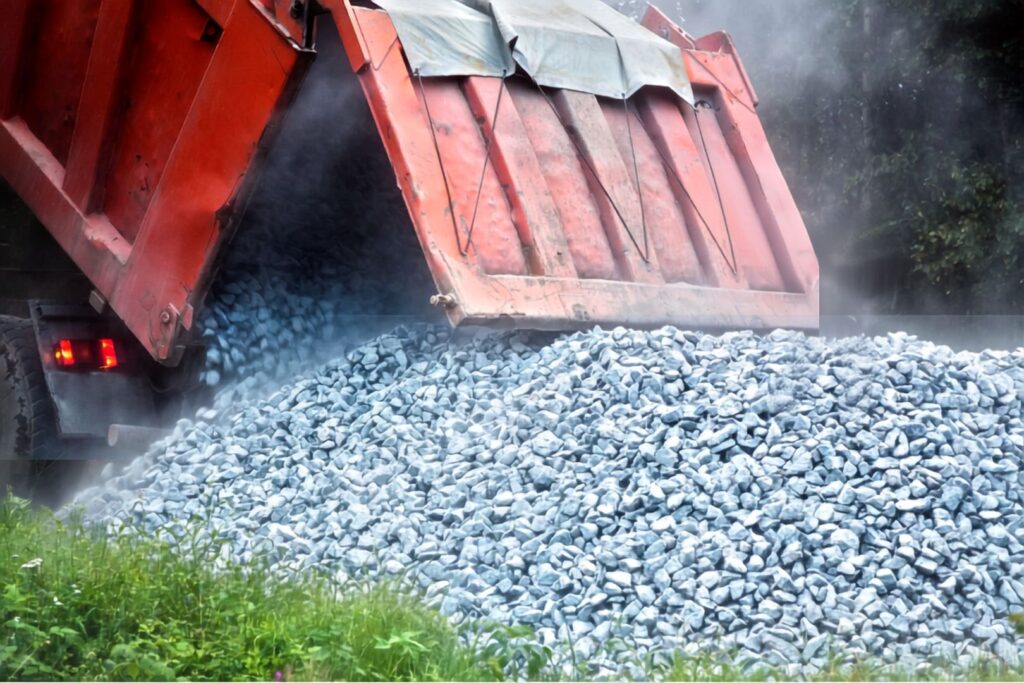
Bulk gravel, dumped off a truck or scooped at a landscape yard, is far cheaper per yard and is the clear choice once you’re past roughly one cubic yard — as long as you have somewhere to dump it and a wheelbarrow to move it where it needs to go. The gravel calculator tells you which side of that line your project falls on.
What type of gravel should you use?
The right stone depends on the job. Pea gravel is small and rounded — great for decorative beds, paths, and play areas, though it shifts underfoot and doesn’t lock in place. Crushed stone (often sold as #57) is angular and roughly three-quarter inch, ideal for driveways, drainage, and French drains because the sharp edges knit together.
Crusher run, also called paver base, mixes stone with fine dust and compacts into a hard, stable layer — the go-to base under driveways and pavers. River rock is larger and smooth for decorative use, and crushed limestone is a common, budget-friendly base and driveway material. If you’re using crusher run or paver base, a hand tamper is worth having — it packs the stone flat and solid so the surface doesn’t shift under weight.
Heavier, denser stone weighs more per cubic yard, which changes your tonnage even when the volume is the same. The gravel calculator adjusts for that automatically when you pick your gravel type.
What you’ll need for the job
Once your gravel calculator numbers are locked in, here’s the gear that makes a gravel project go smoothly. A roll of landscape fabric goes down first to block weeds and keep stone from sinking into bare soil. A landscape rake is the fastest way to spread and level the stone evenly across the area.
If you’re laying crusher run or paver base, a hand tamper packs it flat and stable so the surface holds up under foot traffic or vehicle weight. And for moving bulk gravel from the pile to the project, a dual-wheel wheelbarrow handles the weight without tipping.
Run your numbers through the gravel calculator one more time before you order, and you’ll load up with exactly what the job needs.
Common questions
How much gravel do I need for a 10×10 area?
A 10×10 space (100 square feet) at 3 inches deep works out to about 0.93 cubic yards — just under a yard — which is roughly 1.3 tons or 50 half-cubic-foot bags. At that size you’re right on the bags-versus-bulk line, so it’s worth comparing prices both ways.
How many bags of gravel are in a cubic yard?
About 54 bags if you’re buying the common half-cubic-foot size, or 27 bags of the one-cubic-foot size. That’s why bulk delivery wins on cost for larger areas — you’d be hauling and emptying a lot of bags to equal a single yard.
How much does a yard of gravel weigh?
A cubic yard of gravel weighs roughly 1.3 to 1.5 tons — about 2,600 to 3,000 pounds — with most types landing near 1.4 tons. The exact weight depends on the stone type and how wet it is, since damp gravel weighs more. Keep that in mind if you’re hauling it yourself, and don’t overload a trailer or truck bed.
Is it cheaper to buy gravel in bags or bulk?
Bulk is almost always cheaper per yard once you pass about half a cubic yard, and the gap widens the more you need. Bags only come out ahead on small jobs where convenience, cleanliness, and skipping a delivery fee matter more than the per-yard price.
Planning more of the yard? Our Concrete Per Fence Post Calculator covers setting posts the right way, and the Raised Bed Soil Calculator handles garden beds — both do the math for you, no guesswork required.