
Yardtally is reader-supported. Some links on this page are affiliate links. As an Amazon Associate, Yardtally earns from qualifying purchases. See our Affiliate Disclosure.
Knowing how to choose a furnace filter sounds simple — walk into the hardware store, grab the one with the highest rating, and feel good about your air quality. I used to think the same thing. Then I learned that higher filtration actually works against your furnace and AC, and that chasing the best-looking number on the box can cost you real money in energy bills and equipment repairs. Here’s what I wish I’d known before I started buying filters.
What’s in This Guide
- What the MERV Rating Actually Means
- Why Higher MERV Ratings Can Hurt Your HVAC System
- How to Choose the Right MERV Rating for Your Home
- What About MPR and FPR Ratings?
- How Often Should You Change Your Furnace Filter?
- If You Want Cleaner Air, Buy an Air Purifier — Not a Higher Filter
- Quick Reference — Which MERV Filter Should I Buy?
- Frequently Asked Questions
What the MERV Rating Actually Means
MERV stands for Minimum Efficiency Reporting Value — a standardized scale developed by ASHRAE (the American Society of Heating, Refrigerating and Air-Conditioning Engineers) that rates how well a filter captures airborne particles. The scale runs from 1 to 20. The higher the number, the smaller the particles it can trap. A MERV 8 filter catches dust, pollen, and lint. A MERV 13 filter catches bacteria, smoke particles, and fine allergens. A MERV 20 is hospital-level filtration used in operating rooms. Source: EPA — Guide to Air Cleaners in the Home
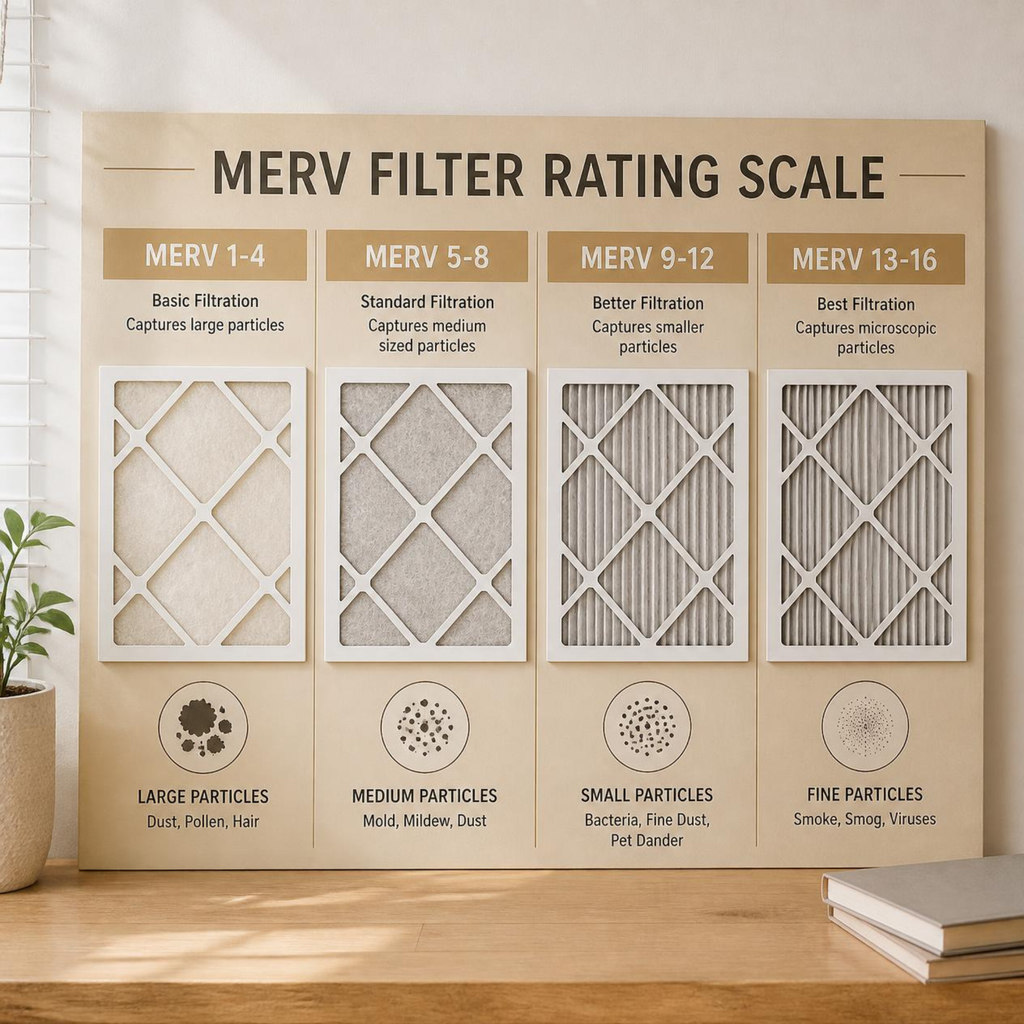
Here’s the part the packaging doesn’t tell you: the denser the filter material, the harder your blower motor has to work to pull air through it. A filter that’s too restrictive for your system starves it of airflow — and that causes real problems.
Why Higher MERV Ratings Can Hurt Your HVAC System
I had a neighbor who swapped his standard MERV 8 filter for a MERV 13 because he read it was better for air quality. Within a few months his energy bills had climbed noticeably and his system was short-cycling — shutting off before finishing a full heating run. An HVAC tech told him the filter was the problem. He switched back to MERV 8 and things went back to normal.
This happens because most residential furnaces and air handlers are designed with a specific airflow requirement. When you install a filter with higher resistance than the system was built for, the blower motor strains to pull air through. Over time this causes overheating of the heat exchanger, reduced efficiency, shorter equipment life, and in some cases damage to the blower motor itself. Using a MERV 13 filter in a system designed for MERV 8 can reduce energy efficiency, spike monthly bills, and potentially damage the blower motor due to airflow restriction.
The other problem is that a clogged high-MERV filter creates even worse restriction than a fresh one. A dirty MERV 13 creates more airflow blockage than a fresh MERV 8. People who buy high-MERV filters and then forget to change them on schedule are doing more damage than if they’d used a basic filter in the first place.
How to Choose the Right MERV Rating for Your Home
Step 1 — Check Your System’s Manual
The single most important thing you can do is look up your furnace or air handler’s maximum MERV rating in the owner’s manual, or find it on the manufacturer’s website. This tells you the highest MERV filter your system can handle without restricting airflow. Most standard residential systems are rated for MERV 8 to MERV 11. Some newer high-efficiency systems can handle MERV 13. Don’t guess — look it up.
Step 2 — Match Your Needs to the Rating
Once you know your system’s limit, pick the rating that fits your household situation:
— Standard home, no pets, no allergies → MERV 8. This is the right filter for most homes. It catches dust, pollen, dust mites, and lint without restricting airflow. It’s inexpensive and widely available.
— Home with pets or mild allergies → MERV 11. Adds capture of pet dander and mold spores. A solid step up without putting stress on most systems.
— Home with asthma, heavy allergies, smokers, or wildfire-prone area → MERV 13. The highest rating the EPA recommends for residential use. Captures bacteria, smoke particles, and fine allergens. Only use if your system supports it.
— Above MERV 13 → Not for residential use. MERV 14 and above are designed for commercial and medical settings. Installing them in a home HVAC system is asking for trouble.
Step 3 — Consider Your Filter Size
If you want higher filtration but your system wasn’t designed for a high-MERV 1-inch filter, there’s a good option: upgrade to a 4 or 5-inch media filter cabinet. The extra depth creates much more surface area, which means the filter can achieve high MERV ratings with far less airflow resistance. A 4-inch MERV 13 media filter puts less strain on your system than a 1-inch MERV 13 filter. This is the right path for people who genuinely need better filtration but don’t want to stress their equipment.
What About MPR and FPR Ratings?
When you’re standing in the filter aisle you’ll see three different rating systems: MERV, MPR, and FPR. MERV is the only standardized one — it’s the industry standard developed by ASHRAE and it means the same thing regardless of brand. MPR (Micro-Particle Performance Rating) is a proprietary system created by 3M for their Filtrete brand filters. FPR (Filter Performance Rating) is Home Depot’s in-house rating system for their store brand. Both roughly correspond to MERV but they aren’t directly equivalent and they’re marketing tools, not engineering standards. When in doubt, look for the MERV number — every filter should list it somewhere on the packaging.
How Often Should You Change Your Furnace Filter?
This matters more than most people realize. A clogged filter — regardless of its MERV rating — restricts airflow just as badly as the wrong filter. I set a phone reminder for every 90 days as a baseline, but the real schedule depends on your household:
— Basic 1-inch filter, standard home: every 1 to 3 months
— Home with one pet: every 60 days
— Home with multiple pets or allergy sufferers: every 30 to 45 days
— 4 to 5-inch media filter: every 6 to 12 months (check the manufacturer’s recommendation)
Don’t wait until you can see visible dirt on the filter. By the time it looks dirty it’s already been restricting airflow for a while. Change on a schedule, not by appearance.
If You Want Cleaner Air, Buy an Air Purifier — Not a Higher Filter

Here’s the thing I tell anyone who asks about furnace filters: if your goal is genuinely cleaner indoor air — for allergies, asthma, or just better air quality — the right tool is a standalone air purifier, not a higher MERV rating on your furnace filter. A MERV 13 furnace filter only cleans the air when your system is actively running. A portable HEPA air purifier runs continuously, filters the air in the room you’re actually in, and does it without putting any strain on your HVAC equipment.
The furnace filter’s real job is to protect the equipment — keeping dust and debris out of the blower, coils, and heat exchanger. It’s not primarily an air quality tool. Treat it like what it is: equipment protection. Use MERV 8 or whatever your system is rated for, change it on schedule, and if you want better air quality in your home, add an air purifier where you spend the most time.
Quick Reference — Which MERV Filter Should I Buy?
Use this to make the decision fast:
— Standard home, no special needs → MERV 8
— Pets or mild allergies → MERV 11
— Asthma, heavy allergies, smokers → MERV 13 (if your system supports it)
— Want cleaner air beyond what a filter can provide → Add a HEPA air purifier
— Never buy above MERV 13 for a residential system
Related Guides
If you’re working on other home maintenance projects, see our guide on how to clean your AC condenser unit.
Frequently Asked Questions About How to Choose a Furnace Filter
What MERV rating should I use for my furnace filter?
For most homes, MERV 8 is the right choice. It captures dust, pollen, dust mites, and lint without restricting airflow or straining your blower motor. If you have pets or mild allergies, step up to MERV 11. If someone in your home has asthma, heavy allergies, or you live in a wildfire-prone area — and your system supports it — MERV 13 is the highest rating the EPA recommends for residential use. Never go above MERV 13 in a home HVAC system.
Is a higher MERV rating always better?
No — and this surprises most homeowners. A higher MERV filter has denser material that restricts airflow more than a lower-rated filter. If your furnace or air handler wasn’t designed for that level of resistance, the blower motor has to work harder, efficiency drops, energy bills climb, and over time you risk overheating the heat exchanger or damaging the motor. Always check your system’s owner’s manual for its maximum rated MERV before buying a filter.
What is the difference between MERV, MPR, and FPR?
MERV is the only standardized rating — it’s the industry standard developed by ASHRAE and applies universally across all brands. MPR (Micro-Particle Performance Rating) is a proprietary system created by 3M for their Filtrete line. FPR (Filter Performance Rating) is Home Depot’s in-store rating system. Both MPR and FPR roughly correspond to MERV but they’re brand-specific marketing tools, not engineering standards. When in doubt, find the MERV number on the packaging — every filter is required to list it.
How often should I change my furnace filter?
It depends on your household. A basic 1-inch filter in a standard home should be changed every one to three months. Add a pet and that drops to every 60 days. Multiple pets or allergy sufferers means every 30 to 45 days. A 4 to 5-inch media filter typically lasts 6 to 12 months — check the manufacturer’s recommendation. The key rule: change on a schedule, not by appearance. By the time a filter looks dirty, it’s already been restricting airflow.
Should I buy a 1-inch or 4-inch furnace filter?
If you need higher filtration but your system wasn’t built for a high-MERV 1-inch filter, a 4 or 5-inch media filter cabinet is the better path. The extra depth creates more surface area, which means the filter achieves higher MERV ratings with far less airflow resistance than a thin filter at the same rating. A 4-inch MERV 13 is significantly gentler on your system than a 1-inch MERV 13. It’s a worthwhile upgrade if air quality is a priority in your home.