
Yardtally is reader-supported. Some links on this page are affiliate links. As an Amazon Associate, Yardtally earns from qualifying purchases. See our Affiliate Disclosure.
If you’re wondering how to overseed a lawn, the short answer is: timing and soil contact are everything. I looked into this carefully before tackling our own thinning lawn, and most overseeding failures come down to two things — seeding at the wrong time of year or skipping the prep work that gets seed touching actual soil. Do those two things right and the rest is straightforward. Here’s exactly what to do.
What’s in This Guide
- What Is Overseeding — and When Should You Do It?
- When to Overseed — Timing by Grass Type
- How to Overseed a Lawn — Step by Step
- Overseeding Aftercare — What to Do Once It Germinates
- Common Overseeding Mistakes
- How Often Should You Overseed?
- Related Guides and Tools
- FAQ
What Is Overseeding — and When Should You Do It?
Overseeding means spreading new grass seed directly over an existing lawn without stripping or tilling. The goal is to thicken thinning turf, fill in bare spots, and introduce fresher, more disease-resistant grass varieties without starting from scratch. It’s different from reseeding (which starts from bare soil) and different from spot patching (which only targets isolated areas). Overseeding treats the whole lawn.
It makes sense when your lawn has thinned out but still has at least 50 percent healthy turf. If it’s mostly dead or dominated by weeds, overseeding won’t fix it — you’d need a full renovation. But for a lawn that’s lost density from foot traffic, drought, disease, or just age, overseeding is one of the most effective fixes available.
When to Overseed — Timing by Grass Type
Cool-Season Grasses
Late summer to early fall — roughly late August through mid-October — is the ideal window for cool-season grasses like Kentucky bluegrass, tall fescue, and perennial ryegrass. Soil is still warm from summer, which drives germination, while cooler air temperatures reduce stress on the new seedlings. The new grass has time to establish before winter without competing with summer weeds. This is the single most important timing window in lawn care. Source: Purdue University Turfgrass Program — Late Winter or Early Spring Overseeding
Warm-Season Grasses
Bermudagrass, zoysiagrass, and centipedegrass should be overseeded in late spring through early summer when soil temperatures are consistently above 65°F. Unlike cool-season grasses, warm-season varieties don’t respond as well to overseeding and many pros skip it entirely in favor of aeration and fertilization. If you do overseed a warm-season lawn, use the same grass type or a compatible variety — mixing species rarely works well.
What About Spring Overseeding?
Spring overseeding of cool-season grasses is possible but less reliable. The germination window is narrower, summer heat arrives quickly and stresses new seedlings, and pre-emergent herbicides applied for crabgrass control in spring will also block grass seed germination. If you missed the fall window, early spring (before soil temperatures climb above 55°F) is your next best option — but fall is always preferred.
How to Overseed a Lawn — Step by Step
Step 1 — Mow Short and Bag the Clippings
Mow the lawn shorter than usual — down to about 1.5 to 2 inches for cool-season grasses. The goal is to reduce the canopy so new seed can reach the soil surface rather than sitting on top of existing grass. Bag the clippings rather than mulching; you don’t want a mat of clippings blocking seed-to-soil contact.
Step 2 — Dethatch if Needed
Run your fingers through the lawn and look at the base of the grass. If there’s more than half an inch of spongy brown thatch — decomposed organic matter between the grass blades and the soil — it needs to come out before you seed. Thatch acts as a physical barrier that prevents seed from reaching soil. A dethatching rake handles small lawns; a power dethatcher rental makes sense for anything over 2,000 square feet.
Step 3 — Aerate (Highly Recommended)
Core aeration is the single biggest thing you can do to improve overseeding success. A core aerator pulls small plugs of soil out of the ground, creating openings that seed falls into and roots can penetrate. Seed that lands in an aeration hole has dramatically better germination rates than seed sitting on a hard, compacted surface. Most lawn and garden rental centers have core aerators available by the day. If you only do one prep step beyond mowing, make it aeration.
Step 4 — Choose the Right Seed
Match the seed to what’s already growing. If you have a tall fescue lawn, use tall fescue seed. Mixing species — fescue into a bluegrass lawn, for example — creates a patchy, inconsistent look that’s hard to fix. Look for seed labeled “improved” or “turf-type” rather than cheap contractor blends, which often contain annual ryegrass that looks great for one season and then disappears. Check the label for germination rate (90% or higher) and weed seed content (as close to 0% as possible) — and when in doubt, a quality grass seed blend from a reputable brand beats a cheap contractor mix every time.
Step 5 — Spread the Seed
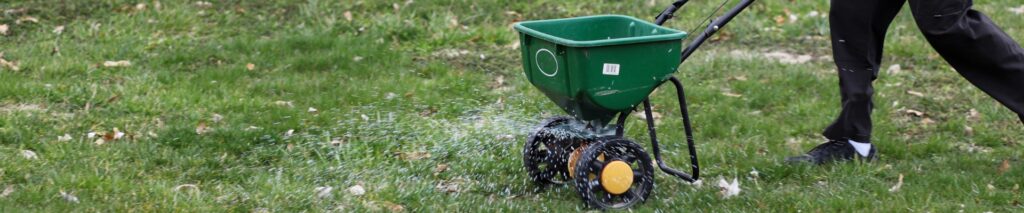
Use a broadcast spreader for even coverage. Set the spreader to the rate recommended on the seed bag for overseeding — not the new lawn rate, which is higher. Walk in two directions (north-south, then east-west) for the most even distribution. Avoid seeding on windy days, which causes uneven coverage. After spreading, use the back of a rake to gently work seed into any aeration holes and improve soil contact.
Step 6 — Apply Starter Fertilizer
Right after seeding, apply a starter fertilizer with higher phosphorus content — something like a 12-12-12 or 18-24-12 formula. Phosphorus drives root development in new seedlings and gives them the strongest possible start. Skip any weed-and-feed product or pre-emergent herbicide at this stage — both will interfere with germination and kill the new seed before it establishes.
Step 7 — Water Consistently
New seed needs consistent moisture to germinate — not soaking, just damp. Water lightly once or twice a day, preferably in the early morning, until germination occurs. Once the new grass reaches about 2 to 3 inches tall, shift back to a normal deep-watering schedule — a soaker hose laid along the lawn makes this easy without soaking the blades.
Overseeding Aftercare — What to Do Once It Germinates
Mowing
Don’t mow until the new grass reaches the same height as the existing lawn — typically around 3 to 4 inches. Mowing too early pulls seedlings before their roots have anchored. When you do mow, don’t remove more than one-third of the blade at a time. Keep foot traffic off the overseeded areas as much as possible for the first three to four weeks.
Watering
Once established, shift from the twice-daily light watering to your normal schedule — deep watering once or twice a week, depending on rainfall. The new grass should be indistinguishable from the existing lawn within four to six weeks of germination under good conditions.
Weed Control
Hold off on any broadleaf herbicide or weed-and-feed application for at least eight weeks after overseeding. Most herbicides that kill broadleaf weeds will also damage or kill young grass seedlings. Once the new grass has been mowed at least three times, it’s generally safe to resume normal weed control.
Common Overseeding Mistakes
Most overseeding failures trace back to one of these:
— Seeding at the wrong time of year — particularly in late spring when summer heat is coming fast
— Skipping aeration — seed sitting on compacted soil has poor germination rates
— Using cheap seed with high annual ryegrass content — looks good briefly, then disappears
— Applying pre-emergent herbicide or weed-and-feed at seeding time — kills new seed
— Not watering consistently — seed that dries out between waterings won’t germinate
— Mowing too soon — pulls seedlings before they’re anchored
How Often Should You Overseed?
For cool-season lawns, overseeding every one to three years is good maintenance practice — not just a repair. Even a healthy-looking lawn benefits from fresh seed because grass plants age, lose vigor, and become more susceptible to disease over time. Annual overseeding in fall keeps the stand dense and competitive against weeds. Think of it like a tune-up rather than an emergency repair.
Related Guides and Tools
If you’re getting your lawn ready for overseeding, these guides cover the steps that come before and after. Our grass seed calculator helps you figure out exactly how much seed to buy based on your lawn size and grass type. If you’ve been dealing with crabgrass before overseeding, our guide on how to get rid of crabgrass covers how to clear it out first so it doesn’t compete with new seed. And if your lawn has bare spots you’re trying to fill, our bare spots in lawn guide covers targeted repair alongside full overseeding.
Frequently Asked Questions About How to Overseed a Lawn
When is the best time to overseed a lawn in Indiana?
Late August through mid-October is the ideal window for overseeding
cool-season lawns in Indiana. Soil temperatures are still warm from summer,
which drives germination, while cooling air temperatures reduce stress on
new seedlings. The new grass has 4 to 6 weeks to establish before winter
without competing with summer weeds. This is the single most important
timing window in lawn care — missing it and trying to overseed in late
October or November typically produces poor results because the seed
doesn’t have enough time to establish before the ground gets too cold.
Do I need to aerate before overseeding?
You don’t have to, but aeration dramatically improves results and is
strongly recommended. Seed that falls into an aeration hole has direct
soil contact, protected moisture, and significantly better germination
rates than seed sitting on a hard, compacted surface. If you only do
one prep step beyond mowing short and removing clippings, make it
aeration. A core aerator rental runs $60 to $100 per day at most home
improvement stores — the improvement in germination success more than
justifies the cost for any lawn larger than a few hundred square feet.
How much grass seed do I need to overseed my lawn?
Overseeding rates vary by grass type — typically 3 to 5 pounds per
1,000 square feet for tall fescue, 2 to 3 pounds for Kentucky bluegrass,
and 5 to 8 pounds for perennial ryegrass. These are overseeding rates —
not new lawn rates, which are higher. Check the label on your seed bag
for the specific overseeding recommendation. Our grass seed calculator
at yardtally.com/how-much-grass-seed-do-i-need/ gives you the exact
amount based on your lawn size and grass type without the guesswork.
Can I overseed without dethatching first?
If your thatch layer is under half an inch, you can skip dethatching —
mowing short and aerating provides enough seed-to-soil contact for good
germination. If thatch is over half an inch, it acts as a physical barrier
between the seed and soil and you’ll see significantly worse results
without removing it first. Check your thatch depth by cutting a small
plug of sod and measuring the brown layer between the soil and the grass
blades. Under half an inch — skip it. Over half an inch — dethatch first,
then aerate, then seed.
How long does it take for overseeded grass to fill in?
Germination takes 7 to 21 days depending on grass type and soil temperature —
perennial ryegrass is fastest (7 to 10 days), Kentucky bluegrass is slowest
(14 to 21 days), tall fescue falls in between. After germination, the new
grass reaches mowable height in 3 to 4 weeks. Full visual recovery —
where the overseeded areas blend evenly with the existing lawn — typically
takes one full growing season. Keep foot traffic off overseeded areas for
the first 3 to 4 weeks and hold off on any herbicide application for at
least 8 weeks after seeding.