
Yardtally is reader-supported. Some links on this page are affiliate links. As an Amazon Associate, Yardtally earns from qualifying purchases. See our Affiliate Disclosure.
Why are my pepper leaves curling? Before you reach for the watering can or start spraying anything, look at which direction the leaves are curling. The direction isn’t random — it tells you the cause before you do anything else. Upward curl during afternoon heat is a heat and drought response. Downward curl with soft, wet-feeling soil is an overwatering problem. Distorted new growth that looks twisted or stunted points to pests or herbicide drift. Get the diagnosis right first and the fix becomes obvious.
This guide covers every common cause of pepper leaf curl, organized by the curl pattern you’re actually seeing — so you can match your plant’s symptom to the right solution without guessing.
What’s in This Guide
- Why Curl Direction Is the Fastest Diagnostic
- Cause 1 — Heat Stress and Drought (Upward Curl)
- Cause 2 — Overwatering and Root Problems (Downward Curl)
- Cause 3 — Aphids (Curled and Distorted New Growth)
- Cause 4 — Spider Mites (Curling with Stippling or Bronzing)
- Cause 5 — Nutrient Deficiency (Curl with Yellowing)
- Cause 6 — Herbicide Drift (Distorted Growth, Entire Plant Affected)
- Cause 7 — Viral Disease (Mosaic or Mottled Pattern with Curl)
- Cause 8 — Physiological Leaf Roll (Nothing to Fix)
- Quick Diagnosis Reference
- FAQ
Why Curl Direction Is the Fastest Diagnostic
A pepper leaf curls in a specific direction because of where the stress is hitting hardest at a cellular level. Heat and drought pull water out of the leaf’s upper surface faster than the lower surface, so the leaf folds upward along the midrib — like a taco shell — to reduce the exposed surface area and slow water loss. That’s a survival response, not a disease.
Overwatering does the opposite. Waterlogged roots can’t function properly, the plant loses turgor pressure, and leaves droop and curl downward — often while looking soft and limp rather than dry and crispy.
Pests feeding on new growth cause distortion because they inject compounds into developing tissue that interfere with normal cell development. The result is twisted, cupped, or asymmetric leaves that look nothing like the flat, healthy ones below them.
Use this as your starting point:
— Upward curl, rolling edges → Heat stress or drought
— Downward curl, soft and drooping → Overwatering or root problems
— Twisted, distorted new growth → Aphids, mites, or herbicide drift
— Curl plus yellowing → Nutrient deficiency
— Curl plus mosaic or mottled pattern → Viral disease (no fix — see below)
— All leaves slightly cupped, otherwise healthy → Physiological leaf roll (normal)
Cause 1 — Heat Stress and Drought (Upward Curl)
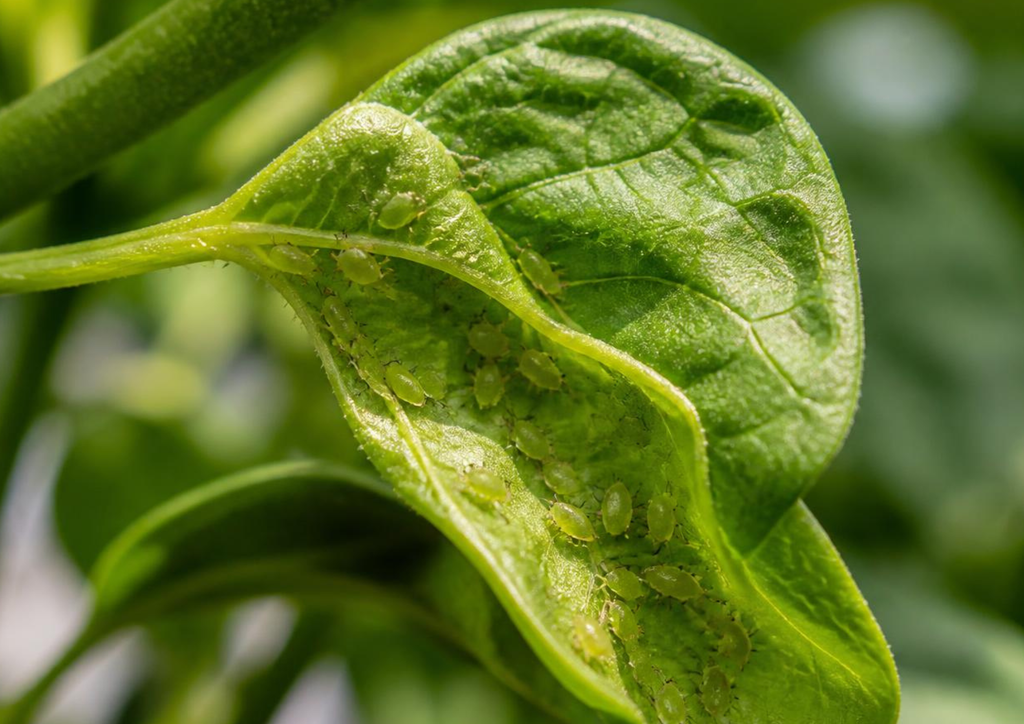
This is the most common cause of pepper leaf curl in summer, and it’s the least urgent. Peppers are warm-season crops but they have a stress threshold — above about 90°F, the plant starts losing water through its leaves faster than the roots can replace it. Leaves fold upward along the midrib to reduce the leaf surface area exposed to sun and slow transpiration. All the plants in a given area will show the response at the same time during the hottest part of the day.
The key diagnostic: if the leaves unfurl on their own by evening or the next morning, heat stress is the cause and the plant is coping. If the curl persists overnight and the soil is dry, you have a drought stress problem that needs water.
The Fix
Water deeply in the morning before temperatures climb — the goal is getting moisture to the root zone, not just wetting the surface. For container peppers, check the soil moisture daily in peak summer; a 5-gallon container in full sun can dry out completely in a single hot day. Our guide on growing peppers in containers covers the right pot size, soil mix, and drainage setup that prevents overwatering from the start. Shade cloth at 30 to 40 percent during the hottest afternoon hours reduces the heat load without cutting off enough light to affect fruiting.
A soil moisture meter tells you exactly what’s happening at root depth rather than at the soil surface, which can be misleading — the top inch dries out fast while the roots may still have adequate moisture below.
Cause 2 — Overwatering and Root Problems (Downward Curl)
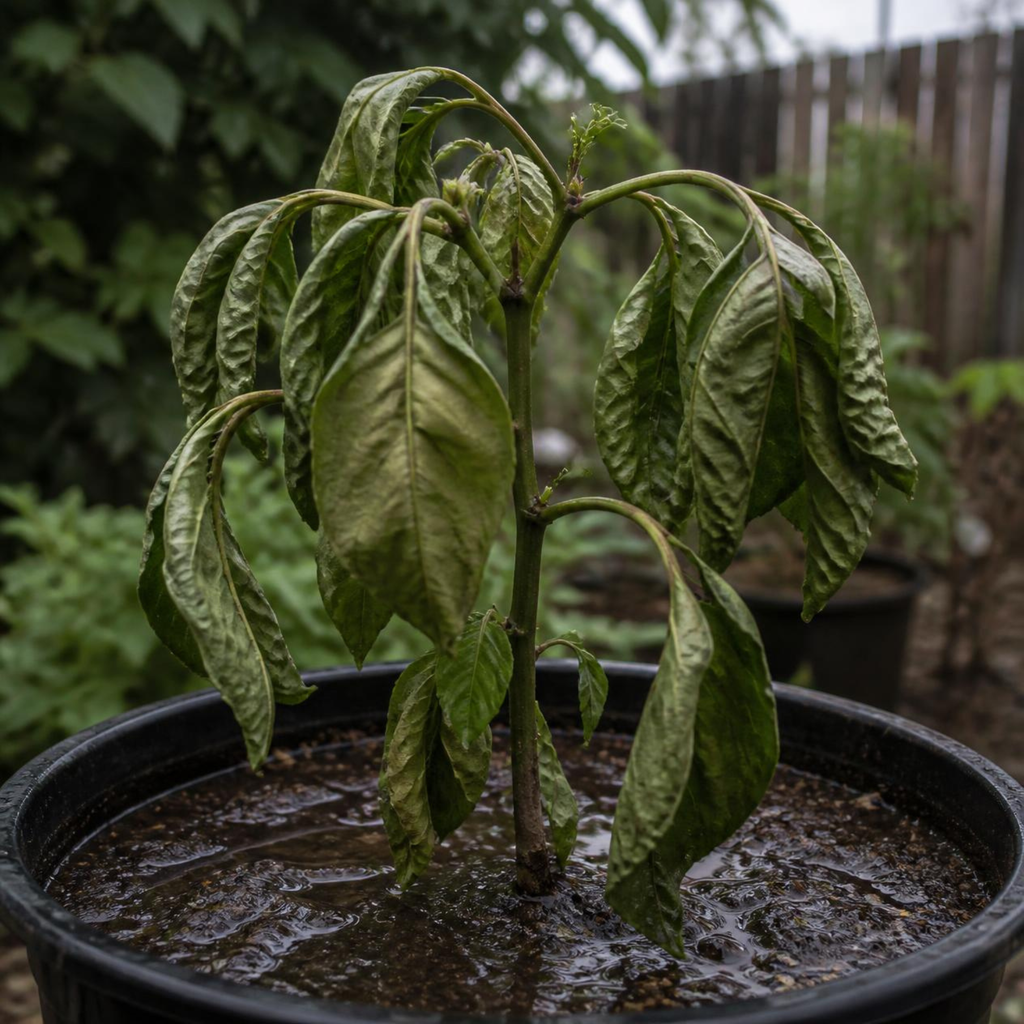
Overwatering kills more container peppers than any other single cause — and it produces symptoms that are often mistaken for drought stress. Waterlogged soil suffocates roots by cutting off oxygen, which triggers root rot and prevents the plant from absorbing water even when the soil is saturated. The result is a pepper that looks wilted and distressed despite being in wet soil.
The distinguishing features: downward curl with soft, limp leaves that don’t feel dry or papery. The soil feels wet or stays wet for more than 2 to 3 days after watering. The pot may feel heavy. In severe cases, the stem near the soil line may look dark or soft — a sign of root rot.
The Fix
Let the soil dry out significantly before watering again. For containers, lift the pot — a dry pot is noticeably lighter than a wet one and that weight check is faster than probing the soil. Make sure drainage holes are clear and functioning. If root rot has set in, remove the plant from its container, trim off any dark, mushy roots with clean scissors, repot in fresh dry soil with added perlite for drainage, and hold off on watering for several days.
For in-ground peppers with downward curl, check whether the planting area drains well after rain. A spot that stays wet for more than 24 hours after rain isn’t suitable for peppers without improving the drainage.
Cause 3 — Aphids (Curled and Distorted New Growth)
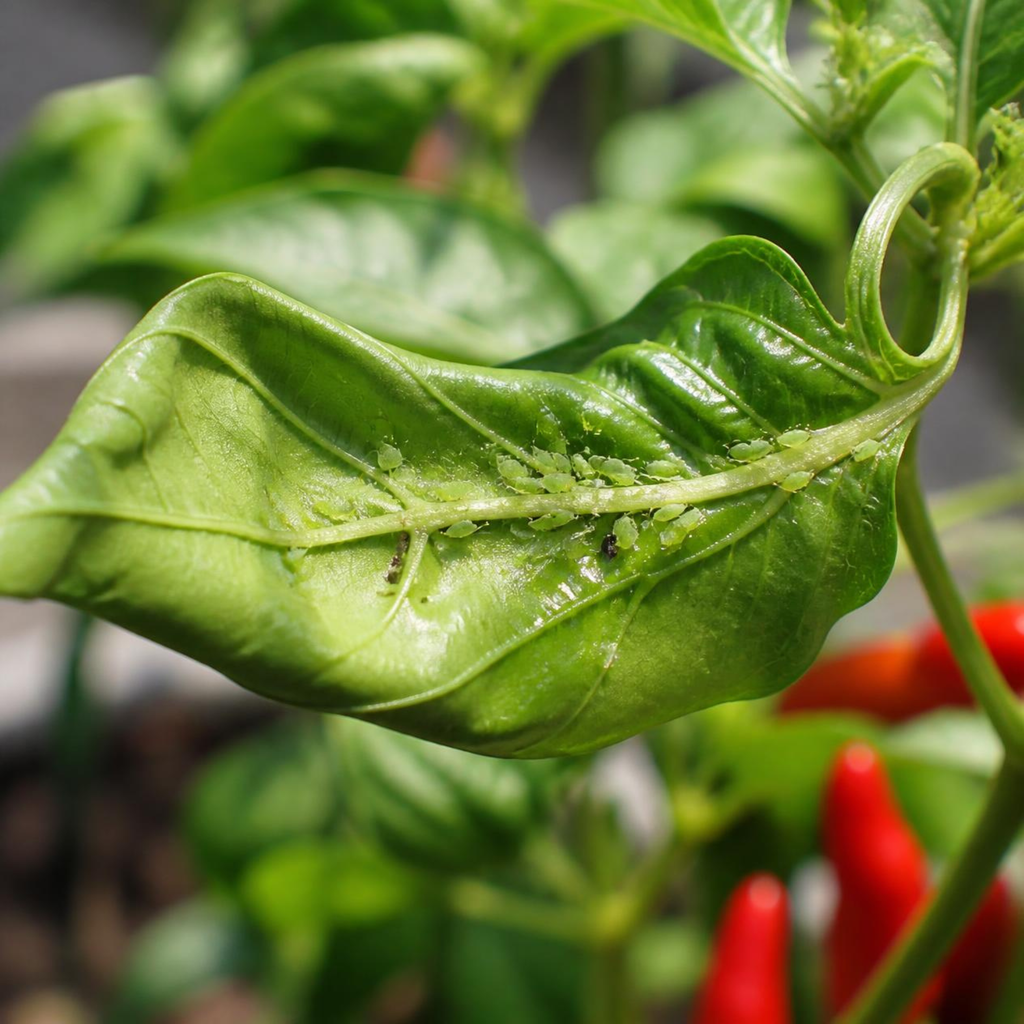
Aphids are soft-bodied insects that cluster on new growth and the undersides of leaves, feeding by piercing plant tissue and extracting sap. Their feeding injects compounds into developing tissue that interfere with normal cell division — the result is new leaves that emerge twisted, cupped, or asymmetrically curled rather than flat. If you flip over the curled leaves and see clusters of small soft-bodied insects — green, black, or tan — aphids are your answer.
Secondary signs: a sticky coating on leaves and stems (honeydew, the sugary waste aphids excrete), ants moving up and down the plant (ants farm aphids for the honeydew), and white shed aphid skins stuck to leaf surfaces.
The Fix
Start with a strong blast of water targeting the undersides of leaves — this knocks most aphids off the plant and many won’t return. For heavier infestations, insecticidal soap spray (one tablespoon of pure castile soap per gallon of water) kills on contact without harming beneficial insects after it dries. Apply in the morning, targeting both leaf surfaces.
For persistent aphid populations, neem oil is the next step up — it disrupts aphid feeding and reproduction and works on spider mites as well. Apply in the evening to avoid harming pollinators.
Neem oil applied in the evening covers both aphids and spider mites with a single product that’s safe for beneficial insects when used correctly.
For a full breakdown of organic aphid control methods, our guide on how to get rid of garden pests without chemicals covers everything that works without harming beneficial insects.
Cause 4 — Spider Mites (Curling with Stippling or Bronzing)
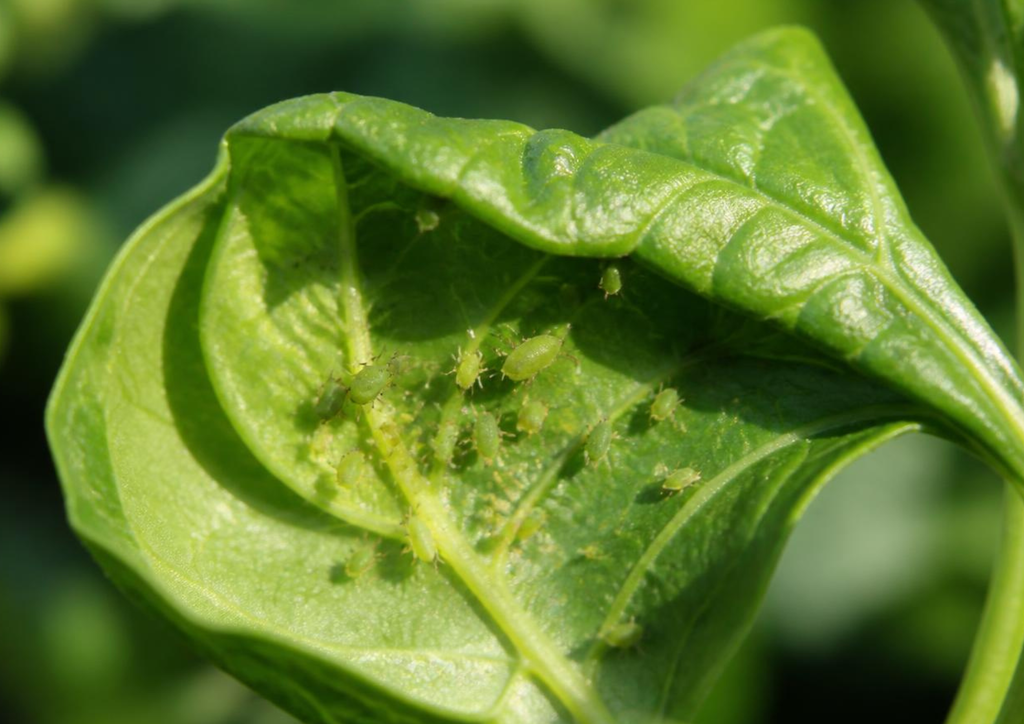
Spider mites are tiny — barely visible to the naked eye — and thrive in hot, dry conditions. They feed on leaf undersides, creating a characteristic stippled or bronzed appearance where each tiny feeding puncture shows as a pale dot. Heavily infested leaves turn yellow-bronze and may curl before dropping. The clearest identifier: fine webbing on leaf undersides and between stems, which looks like a thin dusty cobweb in bad infestations.
Spider mites often appear after a heat wave or after broad-spectrum pesticide use that wipes out the predatory insects that normally keep mite populations in check.
The Fix
Increase humidity around the plants — spider mites hate moist conditions. A strong water spray on leaf undersides knocks mites off and raises local humidity. Neem oil and insecticidal soap both work on mites; apply every 3 to 5 days for two to three weeks to break the reproductive cycle. Avoid broad-spectrum pesticides which eliminate the beneficial predators that naturally control mite populations.
Cause 5 — Nutrient Deficiency (Curl with Yellowing)
Specific nutrient deficiencies cause specific curl patterns on peppers, and matching the pattern to the deficiency points you directly to the fix:
Calcium Deficiency
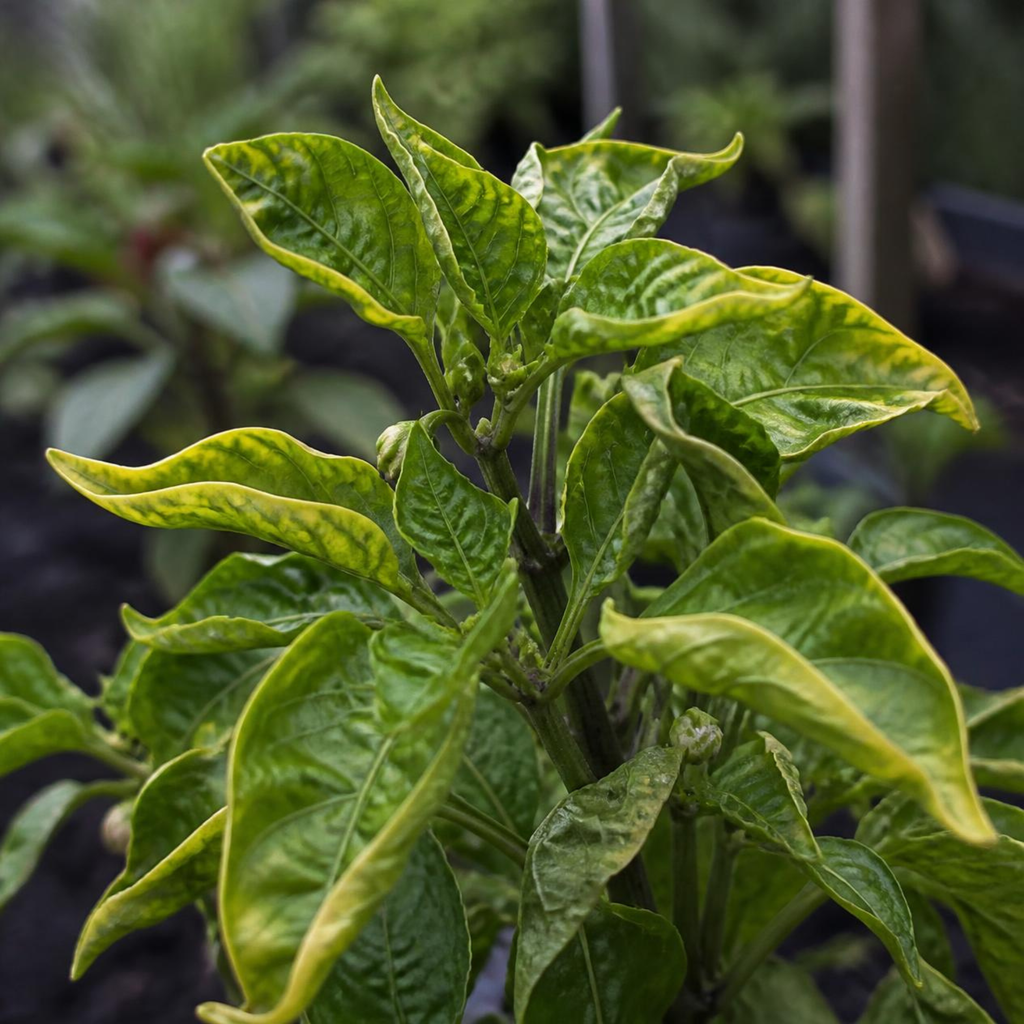
Young leaves and new growth curl, pucker, or develop distorted edges. The older foliage may look fine while new growth looks stunted and malformed. Calcium deficiency is common in fast-draining container mixes that get heavy watering, which leaches calcium before roots can absorb it. Inconsistent watering also contributes — calcium moves through the plant with water flow, and irregular watering creates irregular calcium delivery.
Fix: use a calcium-containing fertilizer and maintain consistent watering. In severe cases, calcium foliar spray directly on affected leaves delivers calcium more quickly than soil amendment.
Potassium Deficiency
Older leaves curl upward at the margins with yellowing along the leaf edges. Unlike nitrogen deficiency (which starts at the bottom and yellows the whole leaf), potassium deficiency causes a distinct edge-yellowing pattern while the leaf center stays green initially. Fix: apply a balanced fertilizer with adequate potassium, or switch to a fertilizer specifically designed for fruiting vegetables.
Nitrogen Excess
Too much nitrogen — particularly from synthetic high-nitrogen fertilizers — causes lush, dark green growth with leaves that cup downward or inward. The plant is putting all its energy into leaf and stem growth at the expense of flowering and fruit set. Blossoms drop and the plant looks impressive but produces little. Switch to a lower-nitrogen fertilizer once the plant is established and flowering has begun.
A balanced fertilizer for peppers and tomatoes applied on a consistent schedule prevents most nutrient-related curl without the risk of over-application that synthetic products carry.
Cause 6 — Herbicide Drift (Distorted Growth, Entire Plant Affected)
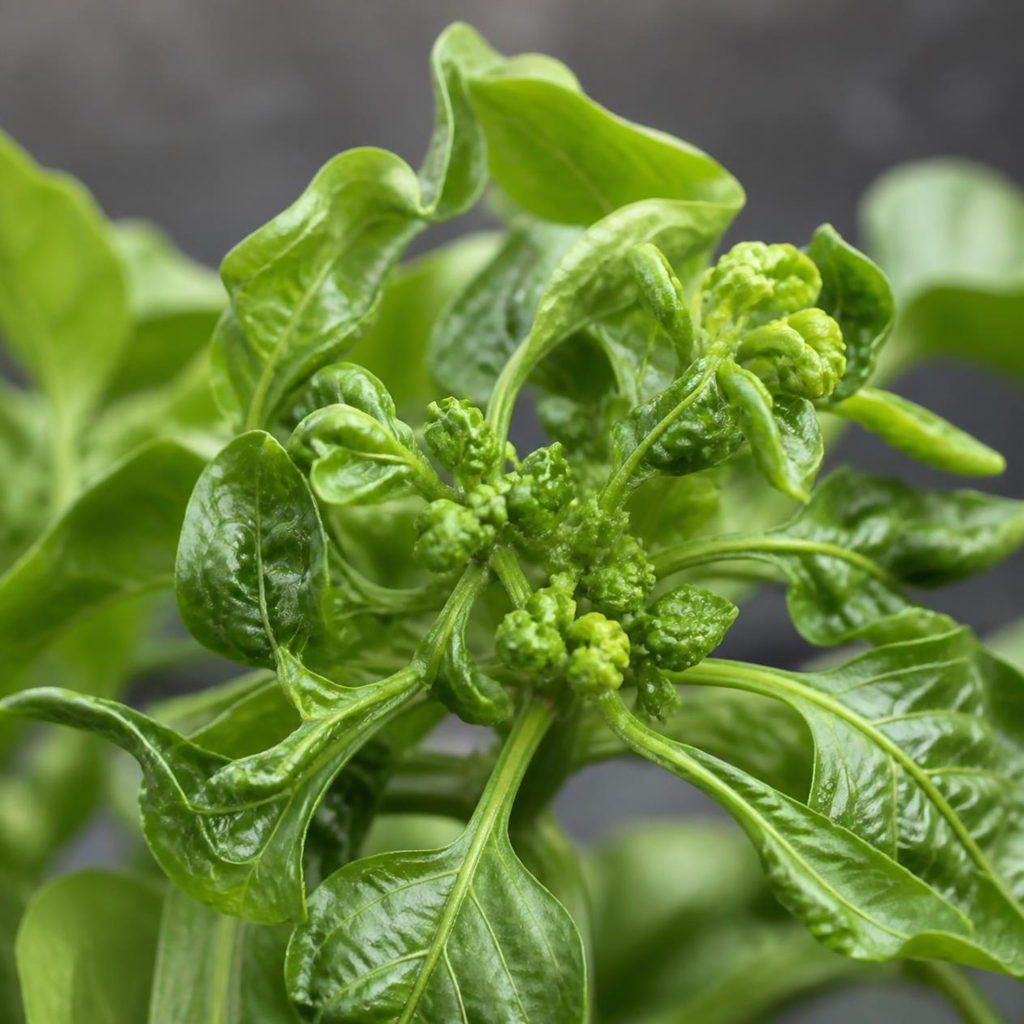
Herbicide drift is the cause most gardeners don’t think of — and it produces some of the most dramatic and alarming symptoms. If a neighbor sprays a broadleaf herbicide on a windy day, or if you spray near your peppers and some drifts, the symptoms appear within a few days: new growth emerges twisted, cupped, and distorted in a way that looks like severe pest damage but without any insects present.
The distinguishing feature is that the distortion affects new growth on the entire plant simultaneously, often multiple plants in the direction of the drift, and there are no insects visible on careful inspection of the undersides. The pattern is also asymmetric and random-looking rather than the organized clustering of aphid or mite damage.
The Fix
There’s no chemical treatment for herbicide drift damage. Remove the most severely affected leaves, give the plant consistent water and nutrition, and wait. Most peppers recover from mild to moderate herbicide exposure over 3 to 4 weeks as new, unaffected growth pushes out above the damaged tissue. Severely affected plants may not fully recover — remove them to prevent them from tapping resources the recovering plants need.
Cause 7 — Viral Disease (Mosaic or Mottled Pattern with Curl)
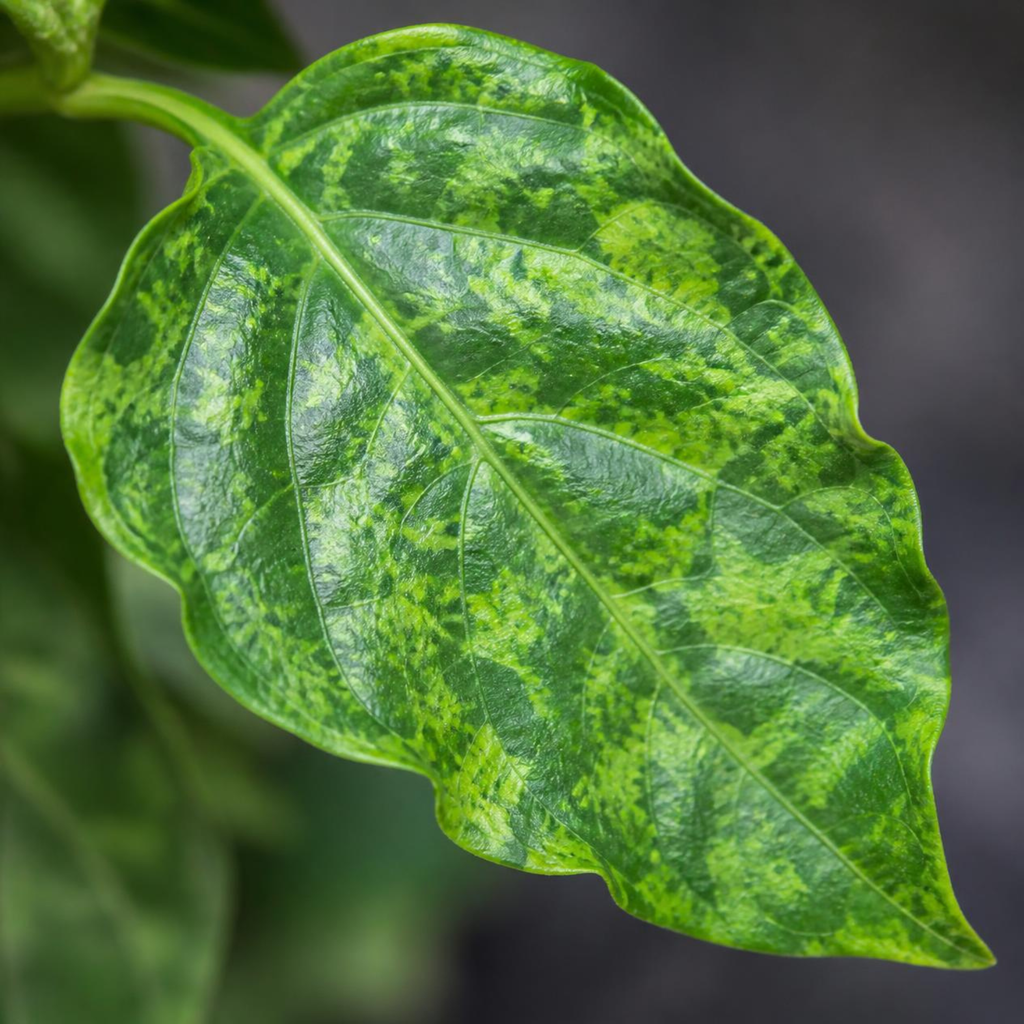
Several viral diseases — pepper mosaic virus, cucumber mosaic virus, tobacco mosaic virus — cause leaf curl alongside a distinctive mottled or mosaic pattern on leaf surfaces. The leaves show irregular light and dark green patches, yellow streaking, or distorted growth that looks almost random. New growth is stunted and malformed.
The critical difference from all other causes: viral symptoms don’t respond to any treatment. The virus is systemic — once a plant is infected, it’s infected throughout. Aphids are the primary vector, transmitting viruses from plant to plant as they feed.
The Fix
Remove and dispose of infected plants in the trash — not the compost pile. Wash your hands and any tools that contacted the plant before touching other plants, as tobacco mosaic virus can be transmitted on hands and tools. Control aphid populations aggressively to reduce the vector that spreads viruses between plants.
Cause 8 — Physiological Leaf Roll (Nothing to Fix)
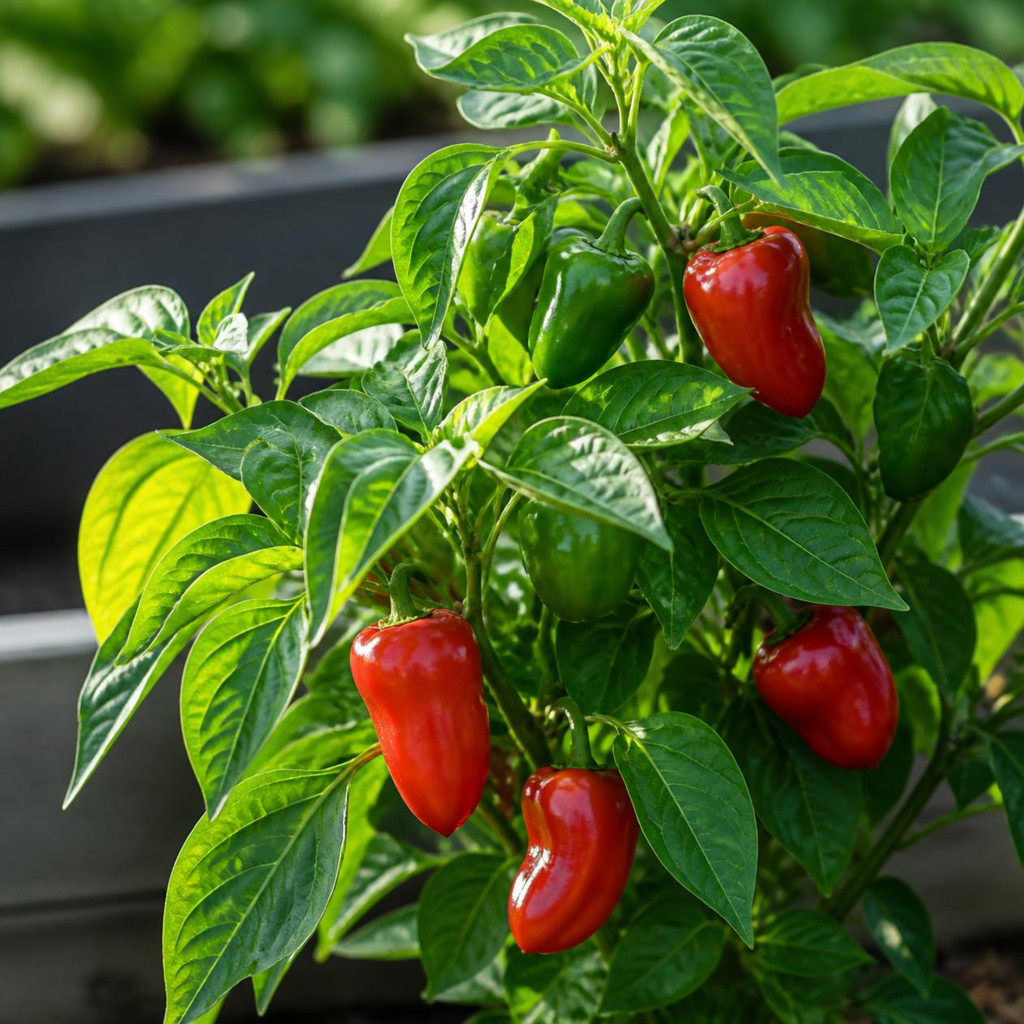
Healthy pepper plants sometimes show a slight upward cupping of leaves — particularly in the afternoon, particularly on mature plants with a heavy fruit load. This is called physiological leaf roll and it’s completely normal. The distinguishing features: the entire plant shows it uniformly, the leaves return to normal by morning, there are no spots or distortion patterns, and new growth is flat and healthy.
If you observe this and can’t find any pest activity, disease symptoms, or watering problems, the most likely explanation is that your pepper plants are healthy and simply managing their water balance during peak heat hours. No action needed.
Quick Diagnosis Reference
Match your observation to the most likely cause before treating:
— Upward curl in afternoon, resolves overnight → Heat stress (normal response)
— Upward curl persists, soil bone dry → Drought — water deeply
— Downward curl, soft leaves, wet soil → Overwatering — let dry out
— New growth twisted and cupped, insects on leaf undersides → Aphids
— Bronze stippling, fine webbing on leaf undersides → Spider mites
— New growth distorted, no insects, recent wind → Herbicide drift
— Curl plus mosaic or mottled pattern → Viral disease — remove plant
— Uniform slight cupping, otherwise healthy → Physiological leaf roll (normal)
Frequently Asked Questions About Pepper Leaves Curling
Why are my pepper leaves curling upward?
Upward curl — where leaves fold along the midrib like a taco shell — is
almost always a heat stress or drought response. The plant reduces the
exposed leaf surface to slow water loss through transpiration. If the
curl appears during the hottest part of the afternoon and the leaves
flatten back out by evening or the next morning, the plant is coping
normally and no intervention is needed beyond consistent morning watering.
If the curl persists and the soil is dry, water deeply immediately. If
the soil is moist and the curl persists, check for root problems that
might be preventing water uptake despite adequate soil moisture.
Why are my pepper leaves curling downward?
Downward curl with soft, limp leaves almost always points to overwatering
or root stress. Waterlogged roots can’t absorb oxygen, which leads to
root rot and prevents the plant from taking up water even when the soil
is saturated. Check the soil — if it’s wet and has been wet for more than
2 to 3 days, overwatering is your answer. Let it dry out significantly
before watering again and ensure drainage holes are clear. Downward curl
can also appear from nutrient excess — particularly high nitrogen — which
pushes too much vegetative growth and causes leaves to cup inward.
Can pepper leaves recover after curling?
Yes — in most cases. Leaves that curled from heat stress, drought, or
overwatering will flatten back out once the underlying condition is
corrected. Leaves distorted by aphid or mite feeding won’t fully recover
their shape, but the plant will produce healthy new growth once the pest
population is controlled. Leaves affected by herbicide drift typically
stay distorted but the plant grows new, normal leaves above the damage
over 3 to 4 weeks. The one situation with no recovery: viral disease.
Once a plant is infected with a mosaic or curl virus, the affected tissue
doesn’t recover and the plant should be removed to prevent spreading.
How do I tell if pepper leaf curl is from pests or heat?
Flip the affected leaves over and look at the undersides carefully. Heat
stress produces uniform upward curl across the whole plant, affects all
leaves simultaneously, and shows no insects on inspection. Aphid damage
produces twisted, distorted new growth specifically — not the whole plant
at once — with clusters of small soft-bodied insects visible on leaf
undersides. Spider mite damage shows a stippled or bronzed surface texture
with fine webbing in the worst cases. If you don’t find insects on careful
inspection and the curl affects the whole plant uniformly during hot
weather, heat stress is almost certainly the cause.
Should I remove curled pepper leaves?
Only if they’re severely damaged, diseased, or showing pest activity that
you want to contain. Leaves that are curled but still green and functional
are still photosynthesizing — removing them reduces the plant’s capacity
to produce energy and recover. For heat stress curl that reverses on its
own, leave the leaves alone entirely. For aphid-damaged new growth that’s
severely distorted, pruning the worst growth while treating the pest
population helps redirect the plant’s energy. For viral disease, remove
the entire plant rather than individual leaves — the virus is systemic
and leaf removal won’t contain it.