
Yardtally is reader-supported. Some links on this page are affiliate links. As an Amazon Associate, Yardtally earns from qualifying purchases. See our Affiliate Disclosure.
If you’ve been trying to figure out the difference between cool season vs warm season grass, the answer changes almost everything about how you care for your lawn. When to fertilize, when to overseed, when to water heavily, when to back off — all of it depends on which type you’re growing. If you’ve ever wondered why your lawn goes brown in summer while your neighbor’s stays green (or vice versa), this is almost certainly the reason. This guide covers how to tell which type you have, how care differs between the two, and how to choose the right grass if you’re starting fresh or reseeding.
What’s in This Guide
- The Core Difference: When Each Type Grows
- How to Tell Which Type of Grass You Have
- Common Cool Season Grasses
- Common Warm Season Grasses
- How Care Differs: Cool Season vs Warm Season
- Which Grass Should You Choose?
- Quick Reference: Cool Season vs Warm Season at a Glance
- FAQ
The Core Difference: When Each Type Grows
The fundamental difference between cool season and warm season grasses comes down to their active growing periods. Cool season grasses thrive when air temperatures are between 60°F and 75°F — which in most of the country means spring and fall are their peak seasons. Warm season grasses hit their stride when temperatures climb to 80°F and above, making summer their prime growing window. Source: Purdue Extension — Fertilizing Established Cool-season Lawns
This growth window difference has a cascading effect on everything else. A cool season lawn in July heat is stressed or dormant. A warm season lawn in October is shutting down for winter. Treating either one the wrong way during the wrong season — fertilizing when it’s dormant, overseeding at the wrong time, watering too aggressively during stress — can do real damage.
How to Tell Which Type of Grass You Have
Before you do anything else, identify what’s growing in your yard. The most reliable clues are behavior, geography, and blade appearance.
Watch When It Goes Dormant
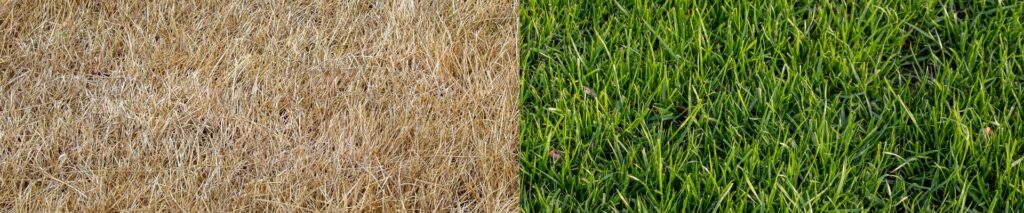
This is the easiest tell. If your lawn turns brown in summer heat and green up again in fall, you almost certainly have cool season grass. If it stays green all summer but goes tan and dormant in late fall through early spring, you have warm season grass. If it greens up in spring, struggles through July and August, then bounces back in September, that’s classic cool season behavior.
Know Your Region
Geography is a reliable shortcut. Cool season grasses dominate the northern half of the United States — the Northeast, Midwest, Pacific Northwest, and upper Plains states. Warm season grasses are the standard in the Southeast, Gulf Coast, and southern Plains. Indiana falls squarely in cool season territory, meaning Kentucky bluegrass, tall fescue, and perennial ryegrass are what you’ll find in the overwhelming majority of lawns here. Source: Purdue Turfgrass Science — Tall Fescue for Indiana Lawns
The transition zone — a band running roughly through Virginia, North Carolina, Tennessee, Arkansas, and into the mid-Atlantic — is where things get complicated. Both types can grow there, and many transition zone homeowners deal with mixed lawns or have to make a deliberate choice between the two.
Look at the Blade
Blade characteristics can help confirm what you’re seeing. Cool season grasses like Kentucky bluegrass have a distinctive boat-shaped tip — the blade narrows to a rounded point that looks like the bow of a canoe. Tall fescue has wide, coarse blades with prominent veins. Warm season grasses tend to look different: bermudagrass has very fine, wiry blades; zoysiagrass is dense and stiff; St. Augustinegrass has wide, flat blades with rounded tips and grows on stolons you can see at the soil surface.
If you’re still not sure after checking behavior and blade shape, your local county extension office can identify a grass sample — and for Indiana, the Purdue Turfgrass website at turf.purdue.edu is a reliable identification resource.
Common Cool Season Grasses
The cool season grasses you’re most likely to encounter in the Midwest and northern states:
Kentucky Bluegrass
The classic northern lawn grass. Kentucky bluegrass produces a dense, rich green turf with that signature boat-tipped blade. It spreads via underground rhizomes, which means it fills in bare spots on its own over time. It handles cold winters well but goes dormant in summer heat and drought. It prefers full sun and doesn’t do well in heavy shade.
Tall Fescue
Tall fescue is coarser than bluegrass but significantly more heat and drought tolerant, which makes it popular in the transition zone and in yards with mixed sun and shade. It grows in bunches (no spreading rhizomes), so bare patches don’t fill in on their own — they need to be reseeded. It stays greener through summer stress than bluegrass does.
Perennial Ryegrass
Fast-germinating and fine-textured, perennial ryegrass is often mixed with bluegrass or fescue in seed blends. It establishes quickly, which is why it’s commonly used for overseeding and repair. It has good wear tolerance but less cold hardiness than bluegrass in extreme winters.
Fine Fescues
Fine fescues (creeping red, chewings, hard fescue) are the shade specialists of the cool season world. They’re the right choice for low-light areas where other grasses struggle, and they require less water and fertilizer than bluegrass. They’re not traffic-tolerant, so they’re best used in low-use shaded areas.
Common Warm Season Grasses
The warm season grasses you’re most likely to encounter in southern and transition zone lawns:
Bermudagrass
Bermudagrass is the workhorse of warm season lawns — aggressive, fast-spreading, extremely heat and drought tolerant, and highly wear-resistant. It spreads via both stolons and rhizomes, which makes it great at filling in bare spots but also a nuisance when it invades garden beds. It requires full sun and goes fully dormant and brown in winter.
Zoysiagrass
Zoysia forms a dense, stiff, carpet-like turf that crowds out weeds effectively. It’s more cold-tolerant than bermudagrass and does reasonably well in partial shade, making it popular in transition zone yards. The tradeoff is that it grows slowly and is slow to green up in spring — sometimes staying dormant well into April or May in cooler areas.
St. Augustinegrass
St. Augustine is the standard lawn grass across the Gulf Coast and Florida. It has wide, flat blades and a coarse texture, and it spreads aggressively via stolons. It handles shade better than most warm season grasses but has poor cold tolerance — it’s not a realistic option north of the transition zone.
Centipedegrass
Centipede is a low-maintenance warm season option popular in the Southeast. It grows slowly, requires less fertilizer than other warm season grasses, and handles acidic soils well. It’s not particularly drought tolerant compared to bermuda or zoysia, and it has little cold hardiness.
How Care Differs: Cool Season vs Warm Season
Fertilizing
This is where getting the type wrong causes the most damage. Cool season grasses should be fertilized primarily in fall (September through November) and secondarily in early spring. Fertilizing a cool season lawn heavily in summer — when it’s stressed or dormant — can burn it and promote disease. Warm season grasses are the opposite: fertilize from late spring through summer when they’re actively growing, and hold off in fall as they head toward dormancy.
Overseeding and Seeding
Cool season grasses are best seeded in late summer to early fall — late August through mid-September in Indiana — when soil is warm but air temperatures are dropping. Spring seeding is possible but less ideal due to summer heat arriving before seedlings fully establish. Warm season grasses should be seeded or sodded in late spring to early summer when soil temperatures are consistently above 65°F. If you’re overseeding a warm season lawn to keep it green through winter, use a cool season grass like perennial ryegrass in fall — a practice called winter overseeding.
Our grass seed calculator can help you work out how much seed to buy based on your grass type and lawn size.
Mowing
Mowing height varies by grass type. Cool season grasses generally perform best kept at 3 to 4 inches — taller during summer stress. Warm season grasses are typically mowed shorter: bermudagrass at 1 to 1.5 inches, zoysia at 1 to 2 inches, St. Augustine at 3 to 4 inches. Never remove more than one-third of the blade in a single mowing regardless of grass type.
Watering
Cool season grasses need the most water support during summer heat when they’re stressed — but if they go fully dormant, you can reduce watering significantly and let them rest until fall. Warm season grasses are generally more drought tolerant during their active season but need consistent moisture to establish. Both types benefit from deep, infrequent watering over shallow, frequent irrigation.
Our lawn watering calculator takes the guesswork out of how long to run your sprinkler based on lawn size and grass type.
Weed Control Timing
Pre-emergent herbicides need to go down before weed seeds germinate — and that timing differs by grass type. For cool season lawns, early spring pre-emergent application targets crabgrass and summer annual weeds. Post-emergent broadleaf weed control works best in fall when cool season grass is actively growing and weeds are taking up herbicide efficiently. For warm season lawns, pre-emergent timing is similar but post-emergent broadleaf control should be done during active growth in late spring or summer — not in fall when the grass is shutting down.
Which Grass Should You Choose?
If you’re reseeding a large area or starting from scratch, here’s how to think through the decision:
Start With Your Region
If you’re in Indiana or anywhere in the northern two-thirds of the country, cool season grass is almost always the right choice. The winters are too cold for most warm season grasses to survive reliably, and zoysiagrass — the most cold-tolerant warm season option — still goes dormant from October through April in Indiana, which means five to six months of a tan lawn every year.
Match the Grass to Your Conditions
Within cool season grasses, the choice comes down to sun exposure, traffic, and how much maintenance you want. Full sun with moderate traffic: Kentucky bluegrass or a bluegrass/ryegrass blend. Full sun with high traffic or heat stress: tall fescue. Heavy shade: fine fescue. Mixed conditions: a blend that includes multiple species handles variation better than a single-species lawn.
Think About Maintenance Expectations
Kentucky bluegrass produces a beautiful, dense lawn but needs consistent fertilization, regular watering in summer, and overseeding every few years to stay thick. Tall fescue is more forgiving — it tolerates heat, drought, and neglect better. If you want a low-maintenance cool season lawn, a quality tall fescue seed blend is often the better long-term choice for Indiana homeowners.
If you’re overseeding rather than starting from scratch, match the seed to what’s already there — or you’ll end up with a patchy lawn of mismatched grass types. Our guide on how to overseed a lawn walks through the full process including seed selection.
Quick Reference: Cool Season vs Warm Season at a Glance
Cool season grasses — peak growth in spring and fall; go dormant or stressed in summer heat; fertilize in fall and early spring; seed in late summer to early fall; common types: Kentucky bluegrass, tall fescue, perennial ryegrass, fine fescues; best for: northern US, Midwest, Pacific Northwest.
Warm season grasses — peak growth in summer; go dormant and turn brown in fall/winter; fertilize in late spring through summer; seed in late spring to early summer; common types: bermudagrass, zoysiagrass, St. Augustinegrass, centipedegrass; best for: Southeast, Gulf Coast, southern Plains.
Transition zone — either type can work; many homeowners use cool season grass with summer stress tolerance (tall fescue) or warm season grass overseeded with ryegrass for winter color.
Frequently Asked Questions About Cool Season vs Warm Season Grass
How do I know if I have cool season or warm season grass?
The easiest tell is dormancy timing. If your lawn turns brown in summer
heat and greens up again in fall, you have cool season grass. If it stays
green all summer but goes tan and dormant from fall through early spring,
you have warm season grass. Geography is the next clue — Indiana and the
entire northern US is cool season territory, meaning Kentucky bluegrass,
tall fescue, and perennial ryegrass are what you’ll find in nearly every
residential lawn. Blade shape is the final confirmation: Kentucky bluegrass
has a distinctive boat-shaped tip; bermudagrass has very fine wiry blades;
St. Augustinegrass has wide flat blades with rounded tips.
Can I mix cool season and warm season grasses?
You can, but the results are usually unsatisfying. The two grass types
have peak growing seasons that are nearly opposite — one is thriving when
the other is dormant — so a mixed lawn looks patchy and uneven through
much of the year. The common deliberate exception is winter overseeding:
seeding a cool season grass like perennial ryegrass over a warm season
lawn in fall to maintain green color through winter. This is common in
the Southeast and transition zone. But for Indiana and the northern US,
a pure cool season lawn is almost always the better choice.
When should I fertilize cool season grass?
Primarily in fall — September through November — and secondarily in early
spring. Fall is when cool season grasses are storing energy for winter
and building root mass, so fertilizer applied then has the most impact
on long-term health. Spring fertilization supports the spring growth
flush. Avoid heavy summer fertilization on cool season grass — it pushes
soft growth during the most stressful period of the year and can promote
disease and thatch buildup.
What cool season grass is best for Indiana?
Tall fescue is the most practical choice for most Indiana homeowners —
it handles heat, drought, shade, and traffic better than Kentucky bluegrass
while still being a true cool season grass that peaks in spring and fall.
Kentucky bluegrass produces a denser, finer lawn but requires more water
and fertilizer and doesn’t tolerate shade well. For a full-sun lawn with
good irrigation and high maintenance, bluegrass or a bluegrass/ryegrass
blend is excellent. For a lower-maintenance lawn or one with mixed sun
and shade, tall fescue is the more forgiving choice.
Why does my cool season grass go brown in summer?
Summer dormancy is a normal stress response for cool season grasses, not
a sign that something is wrong. When air temperatures stay above 85°F for
extended periods, cool season grasses slow or stop growth and may turn
brown to conserve resources — the same way deciduous trees drop leaves
in fall. The grass isn’t dead; the crown and roots are alive and will
green up when temperatures moderate in fall. You can push cool season
grass through summer heat with consistent deep watering, but allowing
it to go dormant is also a valid strategy — less water, less stress,
and it recovers reliably when fall arrives.