
Yardtally is reader-supported. Some links on this page are affiliate links. As an Amazon Associate, Yardtally earns from qualifying purchases. See our Affiliate Disclosure.
If you want to know how to get rid of grubs in lawn, start with the thing most homeowners get wrong: timing. I’ve dealt with it, and the fix is straightforward once you understand one thing most homeowners get wrong: timing.
The right product applied at the wrong time of year does almost nothing. Preventive treatments applied in August don’t work. Curative treatments applied in June are too early. Get the window right and you solve the problem. Here’s exactly how to do it.
What’s in This Guide
- What Are Lawn Grubs?
- How to Get Rid of Grubs in Your Lawn — Know Your Window
- How to Know If You Have Grubs (Not Just Drought or Disease)
- How to Treat Grubs Step by Step
- Will Grubs Come Back Next Year?
- What Doesn’t Work
- FAQ
What Are Lawn Grubs?
Grubs are the larvae of beetles — most commonly Japanese beetles, June bugs, and masked chafers. They live just below the soil surface and feed on grass roots from late summer through fall, then burrow deeper to overwinter and emerge as adult beetles the following spring and summer. The cycle repeats every year.
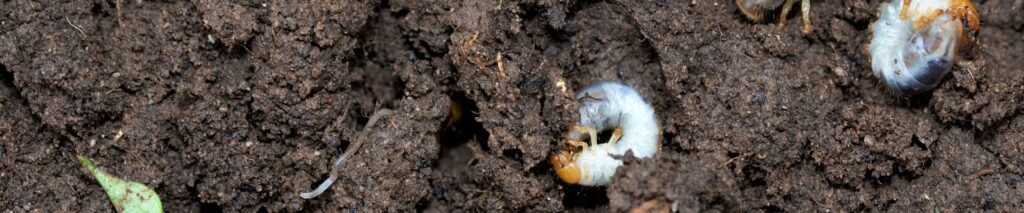
The larvae are easy to identify: white, C-shaped, about the size of your thumbnail, with a brown head. If you dig down 2–3 inches in a damaged area and find six or more per square foot, you have a grub problem worth treating.
How to Get Rid of Grubs in Lawn: Know Your Treatment Window
This is where most homeowners waste money. There are two types of grub treatments and they work in completely different windows:
Preventive Treatment (May–July)
Preventive grub killers contain imidacloprid or chlorantraniliprole and are applied before eggs hatch. They sit in the soil and kill young larvae as they emerge. Scotts GrubEx1 is the most widely used preventive — apply it in May or June before adult beetles start laying eggs, water it in well, and it protects your lawn for the season. This is the right product if you’re being proactive or had grub damage last year.
Curative Treatment (August–September)
If grubs are already active and eating your roots right now, you need a fast-acting curative product. Ortho BugClear Lawn Insect Killer works within 24 hours and kills grubs that are already in the soil. Apply it, water it in deeply (at least half an inch), and give it a week to work through the soil. Curative treatments are less effective on large grubs late in fall — the earlier in August you catch it, the better.
How to Know If You Have Grubs (Not Just Drought or Disease)
Grub damage is often mistaken for summer dormancy or drought stress. Here’s how to tell them apart:
The Tug Test
Grab a handful of brown grass near the damaged area and pull. If it peels back easily with no root resistance — like pulling up a piece of loose sod — grubs have eaten the roots and that’s your answer. Dormant or drought-stressed grass resists pulling because the roots are still intact.
The Dig Test
Cut a 1-square-foot section of sod about 3 inches deep at the edge of a damaged area and fold it back. Count the grubs. The treatment threshold is generally 6–10 grubs per square foot for most grass types. Fewer than that and the lawn can typically outgrow the damage on its own.
Look for Secondary Evidence
Skunks, raccoons, and birds digging up your lawn overnight are a strong sign of grubs underneath — they can smell them. If you’re finding torn-up turf in the morning with no other explanation, dig down and check.
Not sure if it’s grubs or something else? Our what’s wrong with my lawn guide covers lawn disease, fungus, and other common causes of brown patches.
How to Treat Grubs Step by Step
Step 1 — Confirm the Infestation
Do the dig test first. Don’t treat if you’re under threshold — unnecessary pesticide application isn’t good for your lawn or your soil biology.
Step 2 — Choose the Right Product for the Time of Year
May–July: use a preventive like Scotts GrubEx1
August–September: use a curative like Ortho BugClear Lawn Insect Killer
Step 3 — Apply and Water In
Both products require water activation. Apply granular products with a spreader and water in with at least a half inch of irrigation immediately after. Liquid products like Ortho BugClear should also be watered in after application. Dry application without watering is the number one reason grub treatments fail.
Step 4 — Wait and Reassess
Give the treatment 2–3 weeks before re-evaluating. Dead grubs decompose in the soil — you won’t always see them on the surface. What you’ll notice is that the damaged areas stop expanding and the surrounding lawn stays healthy.
Step 5 — Repair the Damage
Once grubs are under control, press any lifted turf back down firmly with a lawn roller. Fill it with water for weight, roll the affected areas, and the roots that are still partially intact may reestablish if watered consistently. For areas where roots are completely gone, you’ll need to reseed.
For bare patches that need fresh seed, our guide on how to overseed a lawn covers the full prep and aftercare process.
Step 6 — Reseed Bare Areas
Rake out any dead material, loosen the top inch of soil, and spread grass seed at the overseeding rate for your grass type. Keep the seed moist twice daily until germination. Fall is the ideal window for cool-season grass repair — soil is still warm and air temps are dropping, which is exactly what cool-season seed needs.
Will Grubs Come Back Next Year?
Probably, if you have adult beetles in your area — and most of the Midwest and Northeast do. The best long-term strategy is a preventive treatment every spring before beetles lay eggs. One application of GrubEx in May or June covers the entire season and is far easier than dealing with damage in August.
What Doesn’t Work
Milky spore (a biological control) is frequently recommended online but only targets Japanese beetle grubs, takes 2–3 years to establish, and is largely ineffective in colder climates. Nematodes require very specific soil temperature and moisture conditions to survive long enough to work. Neither is a reliable fix for an active infestation. Stick with proven chemistry for curative treatment and save the biological options for long-term prevention experiments once your lawn is healthy.
Frequently Asked Questions About Getting Rid of Grubs in Your Lawn
How do I know if I have grubs or just dry grass?
The tug test is the fastest tell — grab a handful of brown grass near the
damaged area and pull firmly. If it peels back with no root resistance,
like lifting a section of loose sod, grubs have eaten the roots underneath.
Dormant or drought-stressed grass resists pulling because the roots are
still intact. If the tug test is inconclusive, cut a 1-square-foot section
about 3 inches deep at the edge of the damaged area and fold it back.
Count the white, C-shaped larvae. Six or more per square foot is the
general treatment threshold — fewer than that and the lawn can typically
outgrow the damage on its own.
When is the best time to treat grubs?
It depends on which type of treatment you’re using. Preventive treatments
containing imidacloprid or chlorantraniliprole — like Scotts GrubEx —
should be applied in May or June before adult beetles lay eggs in the
soil. They sit in the soil and kill young larvae as they hatch. Curative
treatments containing trichlorfon or carbaryl — like Ortho BugClear —
are applied in August through mid-September when young grubs are actively
feeding near the surface. Applying a preventive product in August or a
curative product in May will both produce minimal results. Timing is the
single most important variable in grub treatment success.
How long does it take for grub treatment to work?
Preventive treatments work gradually over the season — they’re in place
before eggs hatch and kill larvae as they emerge, so you won’t see an
acute event. Curative treatments work faster — Ortho BugClear, for example,
is labeled to kill within 24 hours of soil contact. Even so, give any
treatment 2 to 3 weeks before reassessing. Dead grubs decompose underground
— you won’t always see them on the surface. What you’ll observe is that the
damaged areas stop expanding and the surrounding lawn stays healthy.
Do I need to reseed after grub damage?
In areas where the roots are completely gone, yes — the grass won’t recover
on its own. Start by pressing any lifted turf back down firmly with a lawn
roller, then water consistently for a week or two. Areas where roots are
still partially intact may reestablish with adequate moisture. For spots
that don’t green back up within two to three weeks, rake out the dead
material, loosen the top inch of soil, and overseed at the appropriate
rate for your grass type. Fall is the ideal repair window for cool-season
lawns — soil is still warm and air temperatures are cooling, which produces
the fastest germination and strongest root establishment.
Do grubs attract other pests to my lawn?
Yes — and this is often the first visible sign of a grub problem. Skunks,
raccoons, and birds — particularly crows and starlings — can smell grubs
through the soil and will dig up turf to get to them overnight. If you’re
finding torn-up patches of grass in the morning with no other obvious
cause, dig down 2 to 3 inches in the damaged area and check for white
C-shaped larvae. The animal activity is a symptom of the grub infestation,
not a separate problem — treating the grubs eliminates the digging behavior
as well.