
Yardtally is reader-supported. Some links on this page are affiliate links. As an Amazon Associate, Yardtally earns from qualifying purchases. See our Affiliate Disclosure.
Why is my grass growing in patches? It’s one of the most common lawn complaints — and one of the most frustrating — because patchy grass can have a half-dozen different causes, and the fix depends entirely on which one you’re dealing with. I researched this carefully before working through the options, and what I found is that most patchy lawns have one or two primary drivers that, once identified, point directly to the right solution. Here’s how to diagnose what’s causing yours and what to do about it.
What’s in This Guide
- How to Diagnose a Patchy Lawn
- Cause 1 — Soil Compaction
- Cause 2 — Grubs or Other Lawn Pests
- Cause 3 — Lawn Disease
- Cause 4 — Shade and Tree Root Competition
- Cause 5 — Dog Urine Damage
- Cause 6 — Uneven Watering or Drought Stress
- Cause 7 — Thatch Buildup
- How to Repair Patchy Grass
- FAQ
How to Diagnose a Patchy Lawn
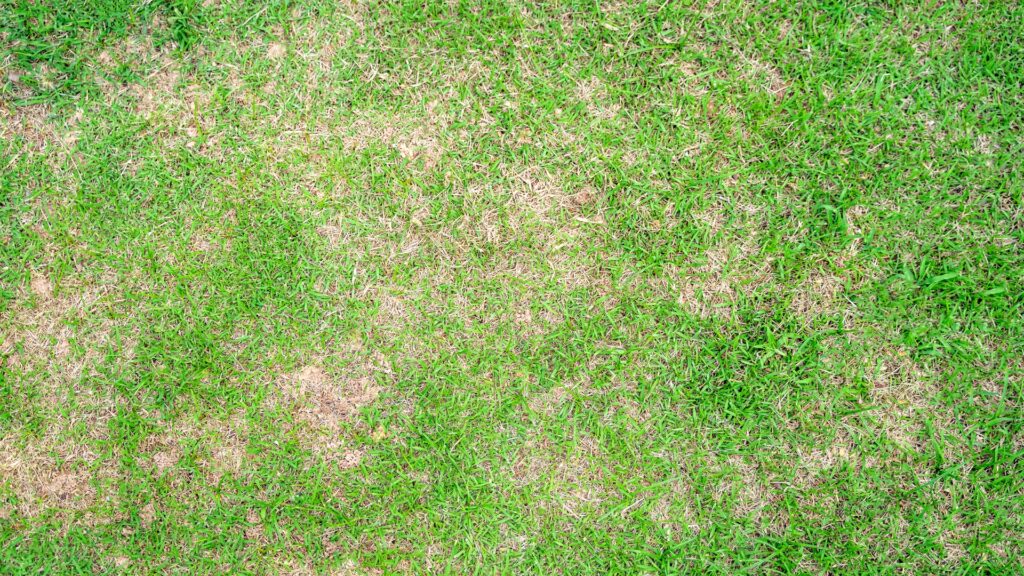
Before spending money on seed or treatments, take five minutes to look at the pattern of the patches. Where they appear and what they look like tells you most of what you need to know.
Patches in high-traffic areas — walkways, play zones, areas near gates — point to compaction. Patches near trees or structures point to shade. Circular or irregular patches with a distinct edge often indicate disease or pests. Patches where a dog regularly goes have a distinctive dark green ring around a brown center. Random scattered patches with no obvious pattern usually point to soil issues, drought stress, or uneven watering. Once you’ve identified the pattern, match it to the causes below.
Cause 1: Soil Compaction
Compacted soil is one of the most common reasons grass grows unevenly. When soil is compressed — from foot traffic, heavy equipment, or simply clay-heavy soil settling over time — grass roots can’t penetrate deeply enough to access water and nutrients. The grass thins out and dies in the most compacted spots while growing normally elsewhere, creating a patchy appearance.
The fix is core aeration — pulling small plugs of soil out of the lawn to loosen compaction and restore air and water movement to the root zone. A manual core aerator handles small areas well; for a full lawn, most home improvement stores rent gas-powered aerators by the day. Aerate in early fall for cool-season grasses, late spring for warm-season. Follow up with overseeding and fertilizer while the soil is open. Source: Purdue Extension — Early Lawn Activities to Consider
Cause 2: Grubs or Other Lawn Pests
Grubs — the larvae of Japanese beetles, June bugs, and other beetles — feed on grass roots just below the soil surface. When the root system is destroyed, the grass dies in irregular patches that pull up like loose carpet. If you can grab a patch of dead grass and roll it back like a rug revealing grubs underneath, pests are your problem.
Check for grubs by cutting a one-foot square of sod about three inches deep in an affected area. More than five grubs per square foot warrants treatment. A grub control product containing imidacloprid or chlorantranilipole applied in late spring to early summer — when grubs are young and near the surface — is the most effective treatment window. Our full guide on how to get rid of grubs in your lawn covers timing, product selection, and lawn repair in detail.
Cause 3: Lawn Disease
Several common fungal diseases cause patchy grass — and they’re often misdiagnosed as drought stress or pest damage. The most common ones to know:
Brown Patch
Brown patch causes circular patches of brown, matted grass — often with a darker “smoke ring” border — and is most common in hot, humid weather when nighttime temperatures stay above 70°F. It spreads quickly in wet conditions and affects tall fescue and ryegrass most severely.
Dollar Spot
Dollar spot creates small, circular brown patches about the size of a silver dollar, often merging into larger affected areas. It thrives in low-nitrogen soil with heavy morning dew. The fix is usually as simple as fertilizing — raising nitrogen levels suppresses dollar spot naturally.
Necrotic Ring Spot
Necrotic ring spot creates rings of dead grass with green grass in the center — a distinctive “frog-eye” pattern. It’s most common in Kentucky bluegrass lawns under drought stress. Improving drainage and overseeding with resistant grass varieties are the primary fixes.
For most lawn diseases, a lawn fungicide applied at the first sign of symptoms stops the spread. Improving air circulation, watering in the morning rather than evening, and avoiding overwatering all reduce disease pressure. Our guide on what’s wrong with my lawn covers how to identify the most common diseases with a visual symptom checklist.
Cause 4: Shade and Tree Root Competition
Grass is a sun-loving plant. Most lawn grasses need at least 4–6 hours of direct sunlight to thrive — less than that and they thin out progressively, creating patchy growth under trees and along shaded walls or structures. Tree roots compound the problem by competing with grass for water and nutrients in the same soil zone.
For shaded areas, switch to a shade-tolerant grass variety — fine fescues are the most shade-tolerant cool-season option and perform well under trees. If an area gets less than 3 hours of sun, grass simply won’t grow well regardless of variety. In those spots, consider switching to a shade-tolerant ground cover, mulch, or a bed of hostas rather than fighting a losing battle with grass.
Overseeding shaded areas with shade grass seed mix in early fall gives the seed the best chance to establish before winter. Keep the area well watered during germination since tree roots compete aggressively for available moisture.
Cause 5: Dog Urine Damage
Dog urine delivers a concentrated dose of nitrogen to a small area, burning the grass roots and creating a brown patch with a distinctive dark green ring around the outside edge — the ring is getting a diluted nitrogen dose that acts like fertilizer while the center gets burned. This pattern is one of the easiest to identify.
Flush affected spots immediately with water after your dog goes to dilute the nitrogen before it concentrates in the soil. For existing damage, flush the area thoroughly, scratch out the dead grass, and reseed. Our full guide on how to fix dog spots in your lawn covers the complete repair and prevention process.
Cause 6: Uneven Watering or Drought Stress
Sprinkler systems with uneven coverage create patchy growth that mirrors the coverage gaps — green grass where water reaches, thin or brown grass where it doesn’t. Drought stress causes grass to go dormant in the weakest spots first, leaving an uneven appearance even when overall watering is adequate.
Check your sprinkler coverage by placing rain gauges around the lawn during a watering cycle — they’ll show you exactly where coverage is light. Adjust sprinkler heads to eliminate gaps. For drought-stressed patches, consistent deep watering — one inch per week, applied in one or two sessions rather than daily light watering — helps grass recover and root more deeply. Our Lawn Watering Calculator can help you figure out the right run time based on your sprinkler’s output and lawn size.
Cause 7: Thatch Buildup
A thick thatch layer — the mat of dead stems and roots that accumulates between the soil surface and the grass blades — blocks water, air, and fertilizer from reaching the roots. Grass weakens unevenly as thatch accumulates, creating patchy growth that gets progressively worse. More than half an inch of thatch is enough to cause problems.
Check thatch thickness by cutting a small plug of sod and measuring the layer of brown material between the soil and the green grass. If it’s over half an inch, dethatching is needed. A thatch rake handles small areas; a power dethatcher or vertical mower handles larger lawns. Dethatch in early fall for cool-season grasses when the lawn can recover quickly. Our guide on how to dethatch a lawn covers the timing, tools, and aftercare in detail.
How to Repair Patchy Grass
Once you’ve identified and addressed the underlying cause, repairing the bare patches follows the same basic process regardless of what caused them:
- Scratch the soil — loosen the top inch with a hand rake to give seed good soil contact
- Apply topsoil or compost — a thin quarter-inch layer over bare patches improves germination
- Seed — use a grass seed matched to your lawn type and the light conditions of the patch
- Cover lightly — a thin layer of straw or a seed accelerator mat retains moisture during germination
- Water daily — keep the seeded area consistently moist until grass reaches 3 inches tall
If you’re not sure how much seed you need for your patches, the Overseeding Calculator gives you the exact amount based on your lawn size and grass type. For larger areas or a full lawn renovation, our guide on how to overseed a lawn covers the complete process.
Frequently Asked Questions About Patchy Grass
Why does my grass grow in patches after seeding?
Patchy germination after overseeding usually comes down to one of three
things: uneven seed coverage, inconsistent moisture during germination,
or seed that isn’t making good contact with the soil. For even coverage,
use a spreader rather than hand-scattering — seed distribution by hand
is almost always uneven. Keep the seeded area consistently moist twice
daily until germination (7 to 21 days depending on grass type and temperature)
— even one day of drying out during germination kills seeds that were
just starting to sprout. Rake the surface lightly before seeding to
create a rough soil texture that holds seed in place rather than letting
it roll off.
Why is my grass patchy in the same spots every year?
Recurring bare or thin spots in the same location every year almost always
point to a persistent underlying condition that reseeding alone won’t fix.
Common culprits: a compaction zone from consistent foot traffic (aerate
and install a stepping stone path), a shallow irrigation gap (adjust
sprinkler heads to cover the area), a shade increase as trees mature
(switch to shade-tolerant seed or convert to a ground cover), recurring
grub activity (treat with a preventive grub control in spring), or a
drainage low spot where water pools and drowns roots (top-dress to raise
the grade). Fix the condition first; the grass will follow.
Can a patchy lawn be fixed without reseeding?
Sometimes — it depends on the cause and how thin the lawn is. If the
grass is thin but not completely dead, addressing the underlying cause
(compaction, drought, shade, grubs) and fertilizing in fall may allow
the existing grass to thicken and fill in on its own over one growing
season. Kentucky bluegrass spreads via underground rhizomes and can fill
small bare spots without reseeding if the surrounding turf is dense and
the cause of the thinning is resolved. Tall fescue doesn’t spread
laterally and won’t fill in bare spots on its own — it requires reseeding.
For significant bare patches, reseeding is almost always the faster path
to a uniform lawn.
How do I fix patchy grass in the shade?
Start by switching to a fine fescue seed blend — it’s the most shade-tolerant
cool-season grass and performs significantly better than Kentucky bluegrass
or tall fescue under tree canopy. Overseed the shaded area in early fall
when temperatures are cooler and the seed has the best chance to establish
before winter. Keep the area consistently watered during germination since
tree roots compete aggressively for available moisture. Raise your mowing
height in shaded areas — 3.5 to 4 inches gives the grass more leaf surface
area for photosynthesis in low-light conditions. If the area gets less
than 3 hours of direct sun, grass won’t thrive regardless of variety —
consider converting it to a shade-tolerant ground cover or mulch bed.
How long does it take to fix a patchy lawn?
After overseeding, germination takes 7 to 21 days and the new grass
reaches mowable height in 3 to 4 weeks. Full visual recovery — where
the patchy areas blend evenly with the surrounding lawn — typically takes
one full growing season. The late August through mid-September window
is the best time to repair cool-season lawns in Indiana — fast germination
in warm soil, strong root establishment before winter, and the repaired
areas come in dense the following spring. Spring repairs work too but
compete with weed germination and summer heat. Whatever time of year you
repair, keep the repaired areas off-limits to foot traffic until the new
grass has been mowed at least two to three times.